Nuclear Fallout Map: How to Read Plumes and Risk Zones
Nuclear fallout map guidance: read wind plumes, timing, and shelter zones without false certainty. Learn the signals that matter.
Staff Reporting and Analysis. Produces source-backed reporting, explainers, and reference pages on nuclear risk, proliferation, and escalation dynamics.
Key Sources
Start with the strongest supporting documents and reporting behind this page.
Primary Documents
Start with the strongest official or documentary records behind this explainer.
Where This Matters Now
Recent articles where this concept is actively shaping the current crisis.
In Current Coverage
Hiroshima and Nagasaki: What Happened When the Bombs Fell
On August 6 and 9, 1945, U.S. atomic bombs devastated Hiroshima and Nagasaki. Here is what happened, who died, and what radiation did after.
2026-03-03
In Current Coverage
Tsar Bomba: The Biggest Nuclear Weapon Ever Tested
Tsar Bomba, tested by the Soviet Union on October 30, 1961, yielded about 57 megatons, becoming the most powerful man-made explosion ever recorded.
2026-03-03
In Current Coverage
What Would Happen If Nuclear War Started? A Step-by-Step Guide
What happens if nuclear war starts? From first launch to nuclear winter: blast zones, fallout, infrastructure collapse, and long-term survival risks.
2026-03-03
Related Comparisons
Comparison pages that show how this concept plays out across rivalries, arsenals, and crisis analogies.
Related Concepts
Companion explainers that deepen the strategic logic around this topic.
Concept
Dirty Bomb vs Nuclear Bomb: Key Differences
Dirty bomb vs nuclear bomb explained: hazard size, radiation risk, survival steps, and when to shelter or evacuate based on official guidance.
2026-03-11
Concept
Radiation Dose Chart: Levels and Risks
Radiation dose chart guide: compare mSv, rem, Gy, symptoms, and emergency action thresholds before you act.
2026-05-27
Concept
Nuclear Flash Blindness Distance: Safety Guide | NukeClock
Nuclear flash blindness distance explained: day vs night ranges, eye injury risk, and immediate actions that reduce harm after a nuclear detonation.
2026-05-11
Nuclear fallout map searches usually come from one urgent question: if fallout moves with the wind, what does a plume on a map actually mean for where to shelter, when to move, and which directions are safer? The answer is not a single radius from ground zero. A useful map separates blast effects from fallout deposition, treats wind direction as a time-dependent input, and keeps household decisions tied to official guidance, not a screenshot.
What does a nuclear fallout map show?
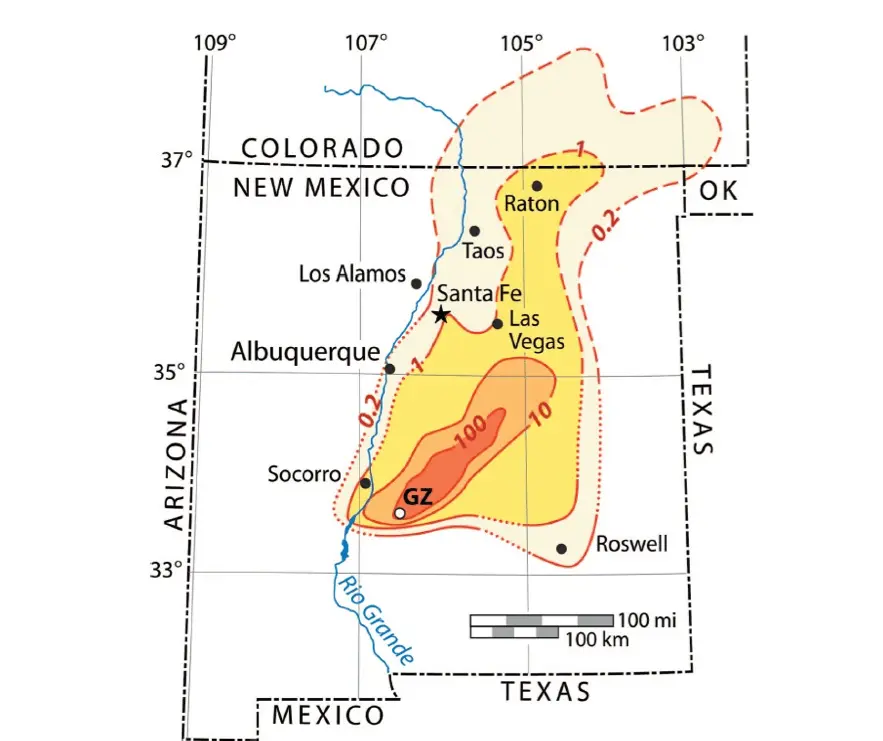
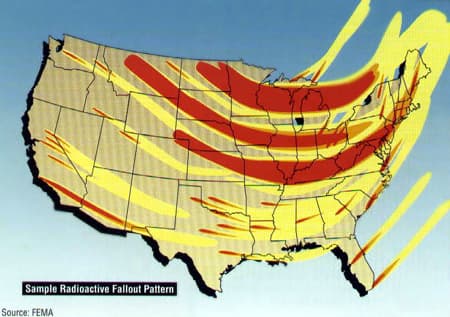
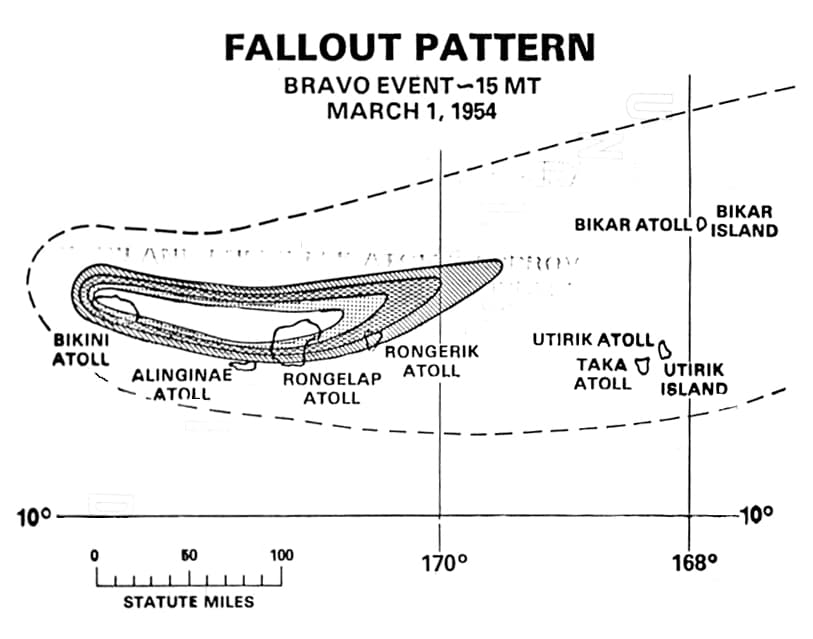
A nuclear fallout map shows where radioactive particles may settle after a detonation. Unlike a blast map, which often uses circular rings around the detonation point, fallout usually appears as an elongated downwind plume. That shape reflects one core fact: fallout is particulate material carried by air movement, then deposited on roofs, roads, soil, water, and people.
The CDC nuclear blast FAQ explains the basic mechanism: vaporized radioactive material cools into particles, falls back to Earth, and can be carried long distances on wind currents. That is why a person outside the worst blast area may still face fallout risk if they are downwind.
The four layers most maps combine
| Map layer | What it means | Common misread |
|---|---|---|
| Detonation point | Where the weapon or release starts | Assuming all risk is circular from this point |
| Plume direction | Where particles are estimated to move | Treating one wind arrow as permanent |
| Dose contours | Estimated radiation level or dose band | Reading color as a precise street-level value |
| Time stamp | When the estimate applies | Using an old map as if it were current |
For civilian decisions, the plume direction and time stamp matter most. If the map does not say when the plume applies, what dose unit is being shown, or whether it is a forecast or measurement, treat it as educational context rather than tactical guidance.
Do not confuse blast rings with fallout plumes
Blast, thermal radiation, and prompt radiation are centered on the detonation. Fallout can travel downwind and create risk outside those rings, especially after a ground burst or surface burst that pulls soil and debris into the fireball.
How do you read fallout plume direction?
Start at the detonation or release point, then follow the long axis of the plume. That axis is the estimated downwind direction for deposited fallout, not a guarantee that every location inside the shape has the same risk. Real plumes can bend, widen, split, and deposit unevenly as winds change by altitude and time.
NUKEMAP's FAQ is useful here because it says plainly that fallout modeling is difficult. It lists burst height, fission fraction, terrain, weather, and wind shear at different cloud altitudes as major variables. The same page also notes that NUKEMAP uses a simplified scaling model, which is helpful for understanding rough size and direction but should not be mistaken for live atmospheric modeling.
A practical plume-reading sequence
- Identify the release point and whether the scenario is a ground burst, surface burst, or airburst.
- Check the map time: H+1, current estimate, forecast hour, or measured deposition.
- Read the plume axis as a direction of concern, not a precise route boundary.
- Look for dose units: R/hr, rad, rem, mSv, or qualitative color zones.
- Compare the plume to official shelter or evacuation instructions for your area.
If those details are absent, use the map only to improve general understanding. In an actual event, emergency managers are combining weather models, field measurements, and infrastructure constraints that a public screenshot may not show.
Is a nuclear fallout map accurate?
A nuclear fallout map can be directionally useful and still wrong in the details. Accuracy depends on the model, input data, and whether the map is a forecast, a historical reconstruction, or a measured contamination product.
Map confidence by data source
| Map type | Strength | Limitation |
|---|---|---|
| Historical measured map | Based on observed fallout after a real event | Not transferable to a different city, season, or burst |
| Simplified simulator map | Good for learning how yield, wind, and burst type interact | Often uses idealized assumptions |
| Weather-model forecast | Can update as winds and release estimates change | Depends on source term and meteorological inputs |
| Field-monitoring map | Best for operational decisions | Arrives after measurements are collected and validated |
NOAA's HYSPLIT system illustrates why professional plume modeling is more than drawing an arrow. NOAA describes it as a system for air parcel trajectories, dispersion, transformation, and deposition, with use cases that include tracking releases of radioactive material. That is the kind of modeling ecosystem public officials may draw from when they refine early estimates.
What H+1 maps can and cannot tell you
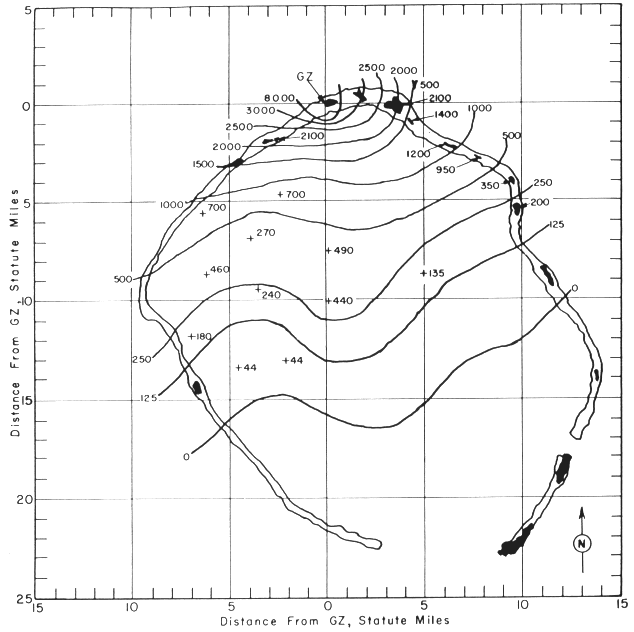
Many fallout contour maps are normalized to one hour after detonation, often written as H+1. This is a standard way to compare deposition patterns, but it is not the same as saying the whole plume arrived everywhere after one hour. Larger clouds can take longer to deposit across the full footprint, and local arrival depends on wind and particle size.
The implication is simple: an H+1 map is a planning abstraction. It helps compare relative hazard zones, but it is not a clock for when your neighborhood is safe or unsafe.
Should you evacuate based on a fallout map?
Not by default. The safest default after a nuclear detonation is to get inside, improve shielding, control contamination, and stay tuned. Ready.gov summarizes the public action pattern as "get inside, stay inside, stay tuned," and the CDC says people already in shelter should stay inside until authorities say it is safe to come out.
A map may tell you that you are downwind, but it may not tell you whether roads are passable, whether fallout has arrived, whether a route crosses a hotter corridor, or whether your current building provides better net protection than travel.
Shelter-first versus movement-first decisions
| Condition | Better default | Why |
|---|---|---|
| Fresh detonation, no route guidance | Shelter first | Outdoor dose and traffic uncertainty are high |
| Weak shelter but stronger shelter is very nearby | Short relocation may help | A fast move to better shielding can reduce total dose |
| Official evacuation order with route and timing | Follow order | Officials are using monitoring and traffic data |
| Medical or structural emergency | Move as needed | Life safety can override radiation optimization |
FEMA's nuclear detonation planning guidance emphasizes that lethal radiation can exist in the first few hours even where fallout is not visually apparent, and that fallout radiation decreases significantly over time. That is why an early map should not push people into traffic unless officials give clear movement instructions.
For a household sequence that starts before map interpretation, use What to Do During Nuclear Alert: A 24-Hour Action Protocol. For choosing the best immediate shielding location, pair this page with Best Room for Nuclear Fallout: Home Shelter Guide.
What is the safest direction to move from fallout?
If officials direct movement and you have a choice of routes, the general logic is to avoid moving downwind through the plume. Crosswind or upwind movement can reduce time in contaminated air and deposition zones, but this is only a rule of thumb. Roads, bridges, fires, blast damage, traffic, and measured dose can make a theoretically good direction impractical.
Direction logic for map readers
| Direction relative to plume | General meaning | Caution |
|---|---|---|
| Downwind | More likely to stay within the plume path | Avoid unless officials designate a controlled route |
| Crosswind | Often exits an elongated plume faster | Verify roads and contamination corridors |
| Upwind | Usually moves away from projected deposition | May be blocked or closer to blast damage |
| Toward dense shelter | May beat all outdoor route options early | Shelter quality can outrank direction in first hours |
The key is sequence. Shelter now, learn the official route later. A person in a decent basement who waits for route guidance may receive less dose than a person who immediately drives across a plume because a map looked narrow.
Why do fallout maps change after the first estimate?
Fallout maps change because the inputs change. Early maps often begin with assumptions: estimated yield, likely burst type, rough location, and forecast winds. Later maps can incorporate field readings, aerial surveys, shelter reports, and better source-term estimates.
Inputs that can move a plume boundary
| Input | Why it changes the map |
|---|---|
| Burst height | Airbursts generally create less short-term local fallout than surface bursts |
| Fission fraction | More fission products can increase radioactive material available for fallout |
| Surface material | Soil, coral, concrete, and water produce different particle behavior |
| Wind shear | Winds at different altitudes can push parts of the cloud in different directions |
| Precipitation | Rain or snow can wash particles down into local hot spots |
| Monitoring data | Measured dose rates replace broad assumptions |
This is also why national "target maps" and viral fallout graphics are usually poor decision tools. They may not define target assumptions, weather conditions, time after detonation, or protective action thresholds. A clear but undocumented map can be more dangerous than a messy official update that explains uncertainty.
How far can fallout travel on a map?
Fallout can travel many miles downwind, and in some historical tests the affected area extended far beyond the immediate blast site. The CDC notes that fallout particles can end up miles from the explosion, while historical ground and surface burst cases show highly directional contamination patterns.
Distance still matters, but not as a circle. A location 30 miles downwind can be more relevant than a location 10 miles upwind, depending on deposition and timing. At the same time, being inside a well-shielded structure can reduce exposure dramatically compared with being outside in a lower-dose zone.
Distance questions a good map should answer
| Question | Why it matters |
|---|---|
| Is this showing dose rate or total dose? | Dose rate affects time outside; total dose summarizes accumulated exposure |
| Is the map for local fallout or global fallout? | Local fallout drives immediate shelter decisions |
| What time after detonation is shown? | Early and late maps can differ sharply |
| Does the map include precipitation? | Rainout can intensify localized deposition |
| Does the map include shelter assumptions? | Outdoor contours may overstate indoor dose if shielding is good |
For the decay side of the problem, read How Long Does Nuclear Fallout Last? A Practical Timeline. That page explains why the first 24 to 48 hours dominate many immediate shelter decisions.
How should you use NUKEMAP fallout overlays?
Use NUKEMAP fallout overlays as a teaching tool, not as a personal emergency order. They are valuable because they make abstract variables visible: yield, burst height, fission fraction, wind direction, wind speed, and shelter assumptions. They are limited because real fallout depends on detailed weather and source-term data that a browser-based scenario may not know.
Best uses for simulator maps
- Learn the difference between blast rings and fallout plumes.
- Compare how surface burst and airburst choices affect local fallout.
- See why wind direction matters more than simple mileage.
- Stress-test household shelter assumptions.
- Understand why official route guidance can differ from intuition.
Bad uses for simulator maps
- Predicting exact street-level safety in a real event.
- Choosing evacuation routes without official instructions.
- Assuming one saved screenshot applies to all seasons or times.
- Treating a color contour as a guaranteed casualty forecast.
- Ignoring shelter quality and time indoors.
If a simulator helps you choose better shelter now, it has done useful work. If it makes you think you can outrun a plume in the first hour without verified information, it is being used the wrong way.
What map terms matter most?
Fallout maps use technical language. You do not need to become a radiation physicist, but you should know the terms that change decisions.
Quick glossary for map interpretation
| Term | Plain meaning | Decision relevance |
|---|---|---|
| Plume | The estimated path and spread of airborne or deposited material | Shows direction of concern |
| Deposition | Material settling onto surfaces | Drives contamination control |
| Dose rate | Radiation per unit time | Determines how costly outdoor time is |
| Total dose | Accumulated exposure over a period | Helps compare route or shelter choices |
| Hot spot | Local area with higher-than-surrounding contamination | Can make short detours important |
| Source term | Estimate of what was released | Major input to model accuracy |
| Protection factor | Shelter dose reduction compared with outside | Explains why building choice matters |
The EPA's Protective Action Guides exist because response decisions depend on dose thresholds and practical protective actions, not map colors alone. A map becomes useful when it supports a protective action: shelter, controlled evacuation, food and water advisories, responder routing, or reentry limits.
How should households turn a fallout map into actions?
Households should not try to out-model emergency managers. The practical goal is to use maps to ask better questions and avoid bad default behavior.
A household map-reading protocol
| Step | Action | Why it helps |
|---|---|---|
| 1 | Shelter immediately before analyzing maps | Prevents exposure while information is incomplete |
| 2 | Identify the map source and time stamp | Filters stale or unsourced graphics |
| 3 | Determine whether the map is forecast, simulator, or measurement | Sets confidence level |
| 4 | Compare your location to plume direction, not just distance | Avoids false circular-risk assumptions |
| 5 | Wait for official route or shelter guidance | Connects map reading to validated action |
| 6 | If exposed, decontaminate before settling into shelter | Reduces transfer of particles indoors |
For decontamination steps after outdoor exposure, use How to Decontaminate After Nuclear Fallout. For supplies and first-day logistics, use Nuclear Shelter Checklist: 24-Hour Plan.
Print decisions, not maps
A saved fallout map can become stale quickly. A printed household protocol is more durable: shelter room, radio channels, decontamination steps, family check-in times, and exit triggers.
How should local planners explain fallout maps to the public?
Local planners have a harder task than households: they must publish maps without creating false precision. The public needs simple commands, but the technical product behind those commands is uncertain and changing.
Public-facing map design rules
| Design choice | Better approach |
|---|---|
| Bright danger colors without definitions | Label colors with action thresholds |
| No map time stamp | Show issued time and next update window |
| Single plume line | Use uncertainty bands or text caveats |
| No protective action text | Pair each zone with shelter or movement instructions |
| Static social graphic only | Provide radio, SMS, web, and print versions |
Good public guidance does not ask residents to solve a dispersion problem. It tells them whether to remain sheltered, move to a better nearby shelter, prepare for later evacuation, or follow a named route at a named time.
What a strong official update includes
- Area affected.
- Protective action.
- Start time and review time.
- Route or shelter details.
- Food, water, and contamination instructions.
- Accessible language for people without map literacy.
This is where maps and emergency communication meet. A map without action language creates interpretation load exactly when people have the least bandwidth.
How can you spot a misleading nuclear fallout map?
A misleading map is not always fake. Sometimes it is real but used outside its context. A Cold War national map, a historical test map, or an educational simulator can all become misleading when shared as if they predict today's local conditions.
Red flags in viral fallout maps
| Red flag | Why it matters |
|---|---|
| No source | You cannot evaluate inputs or purpose |
| No time stamp | Fallout maps are time-dependent |
| No units | Color alone does not tell dose or dose rate |
| No burst assumptions | Airburst and surface burst maps differ |
| No wind assumptions | Plume direction cannot be checked |
| No protective action | Users may improvise unsafe movement |
| Too much precision | Street-level certainty is rare early |
The better habit is to treat unofficial maps as prompts for preparation: choose shelter, stage supplies, and learn official channels. During an actual emergency, the controlling information should come from local emergency management, public health, state agencies, FEMA-linked channels, radio, or other verified sources.
How does a fallout shelter map differ from a fallout plume map?
A fallout shelter map shows where protective buildings or designated spaces may exist. A fallout plume map shows where radioactive material may travel or deposit. They answer different questions.
Shelter map versus plume map
| Map | Main question | Risk if misused |
|---|---|---|
| Shelter map | Where can I reduce exposure indoors? | Assuming old shelter listings are operational |
| Plume map | Where is contamination likely or measured? | Assuming travel through the plume is safe |
| Blast map | What areas face pressure, thermal, and prompt effects? | Ignoring fallout outside blast rings |
| Evacuation map | Which route and timing should people use? | Treating generic direction advice as official routing |
Older civil-defense shelter signs can still mark dense structures, but many listed shelters may not be stocked, staffed, or maintained. A good immediate shelter is often simply the best available interior space: basement, underground level, or central concrete core.
Bottom line: what should a nuclear fallout map change?
A nuclear fallout map should change your interpretation, not your first action. It should teach you that fallout risk is wind-shaped, time-dependent, and model-limited. It should not make you delay sheltering while you chase a perfect map.
The practical sequence is stable:
- Get inside fast.
- Move to better shielding.
- Reduce contamination transfer.
- Stay tuned to official updates.
- Use maps to understand instructions, not replace them.
That sequence is consistent with federal public guidance and with the way professional response maps improve over time. If you remember only one idea, make it this: plume maps are decision support, not permission to self-evacuate.