What Would Happen If Nuclear War Started? A Step-by-Step Guide
What happens if nuclear war starts? From first launch to nuclear winter: blast zones, fallout, infrastructure collapse, and long-term survival risks.
Staff Reporting and Analysis. Produces source-backed reporting, explainers, and reference pages on nuclear risk, proliferation, and escalation dynamics.
Key Sources
Start with the strongest supporting documents and reporting behind this page.
Country Profiles Mentioned
Open the profile pages for the countries referenced directly in this article.
China
600 warheads · GFP #3
France
290 warheads · GFP #6
India
172 warheads · GFP #4
Iran
No nuclear weapons · GFP #17
Israel
90 warheads · GFP #15
North Korea
50 warheads · GFP #31
Pakistan
170 warheads · GFP #14
Russia
5,580 warheads · GFP #2
United Kingdom
225 warheads · GFP #8
United States
5,044 warheads · GFP #1
Related Rivalries
These comparison pages help place this article inside the broader balance of power and rivalry structure.
Rivalry
Is This Like the Cuban Missile Crisis? Comparing 1962 and 2026
A 1962 vs 2026 comparison of decision windows, nuclear proximity, escalation control, and why the Iran crisis is framed as a modern Cuban Missile moment.
2026-03-03
Rivalry
Iran War vs Iraq War: How the 2026 and 2003 Conflicts Compare
Iran 2026 vs Iraq 2003 compared across legal authority, coalition structure, force design, economic shock, and the central role of nuclear risk.
2026-03-03
Rivalry
Russia vs US Nuclear Forces: 2026 Strategic Comparison
Russia and US nuclear forces compared by warheads, delivery systems, modernization, spending, and doctrine across the world's two largest arsenals.
2026-03-03
Related Doctrines
These explainers provide the strategic concepts behind the escalation, deterrence, and risk logic discussed here.
Doctrine
How Many Nukes Would It Take to Destroy the World?
How many weapons could trigger civilization-scale collapse? We break down nuclear-winter science, blast and fallout effects, and risk from limited exchanges.
2026-03-03
Doctrine
What Is Mutually Assured Destruction (MAD)?
What is mutually assured destruction (MAD)? We explain the doctrine, Cold War logic, modern criticisms, and why MAD still shapes nuclear strategy.
2026-03-03
Doctrine
Who Has the Most Nuclear Weapons? Complete 2025 Ranking
Who has the most nuclear weapons in 2025? Ranked totals for all nuclear-armed states, plus trends in modernization, expansion, and strategic balance.
2026-03-03
If nuclear war started today, the first missile would arrive before most people knew it had been launched. The physical effects — blast, heat, radiation — would be followed by cascading failures in food, power, water, and medicine that could kill more people than the bombs themselves. This is what the science says would happen, step by step.
The First 30 Minutes: Launch, Warning, and Impact
Nuclear war does not begin with a bang most people hear. It begins with a data point on a radar screen.
Launch detection
The United States operates a layered early warning system. Space-based infrared satellites (SBIRS) detect the heat signature of a ballistic missile within seconds of launch. Ground-based radar stations track the missile's trajectory and calculate a predicted impact point. This data flows to NORAD's command center in Colorado within minutes.
The President is notified. The nuclear football — a briefcase carried by a military aide that travels with the President at all times — contains the decision tools. The President has authenticated codes and can order a launch in minutes, with no requirement for Congressional approval or secondary confirmation.
Warning time by scenario:
| Launch type | Distance | Warning time |
|---|---|---|
| ICBM from Russia/China | 5,500–8,000 miles | 25–30 minutes |
| SLBM from Atlantic submarine | ~1,500 miles | 8–12 minutes |
| SLBM from close-in submarine | 300–600 miles | 3–6 minutes |
| Hypersonic glide vehicle | Variable | 5–10 minutes |
| Cruise missile (low-observable) | 500–1,000 miles | 0–15 minutes |
A President facing a confirmed incoming strike has, at most, ten minutes to make a decision. Advisors recommend. The President decides alone.
Launch under attack
US nuclear doctrine permits "launch under attack" — launching American missiles before incoming warheads detonate, to prevent them from destroying land-based ICBMs. This means nuclear war can be initiated and cannot be recalled. Once missiles are in the air, no code retracts them.
The first detonation
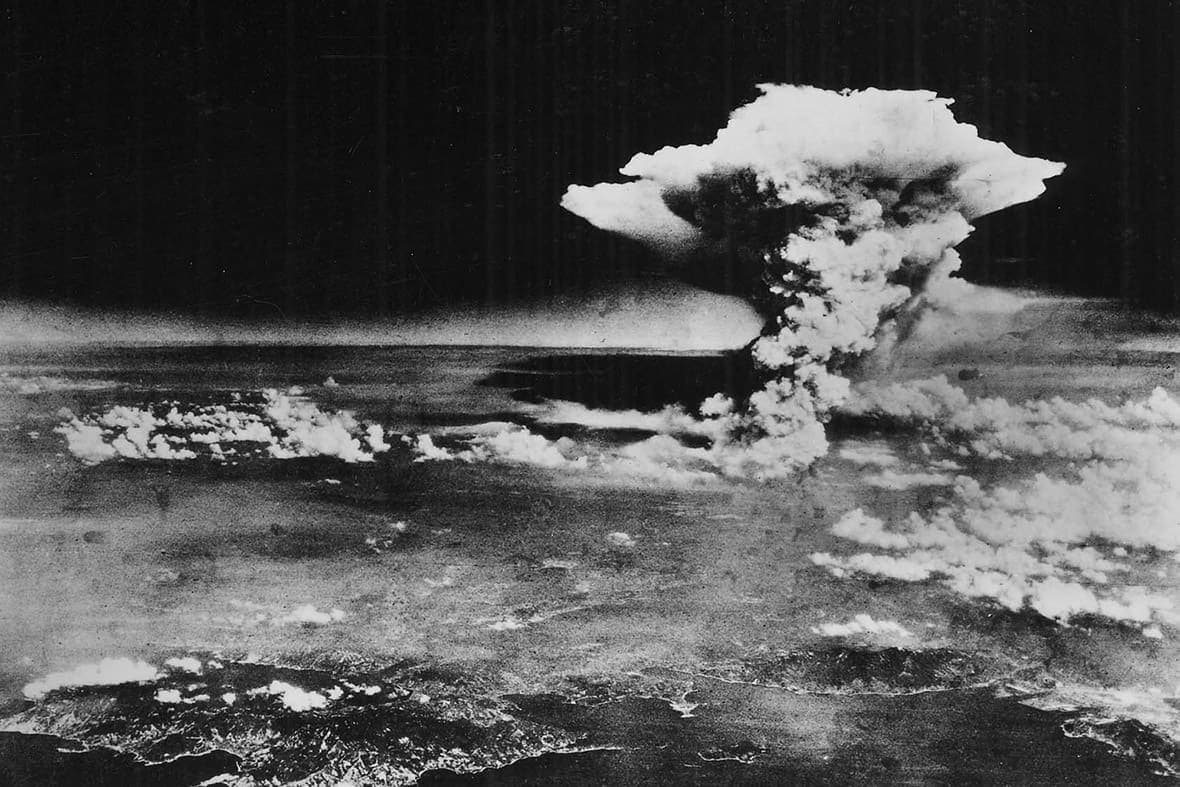
A 300-kiloton warhead — roughly representative of a modern Russian SS-18 reentry vehicle — detonating above a city produces four distinct lethal zones simultaneously.
Fireball zone (radius ~0.5 km from ground zero): The fireball reaches temperatures of several million degrees Celsius — hotter than the surface of the sun. Everything within this zone is vaporized instantaneously. There are no survivors.
Severe blast zone (radius ~2–3 km): Overpressures of 20 psi or more collapse reinforced concrete buildings. Air pressure equivalent to 140 mph winds carries building debris at lethal velocities. Most people in this zone die from blast, crush injury, or flying debris within seconds.
Moderate blast zone (radius ~5–8 km): Overpressures of 5–10 psi shatter windows, collapse residential buildings, and cause severe burns. Mortality in this zone is high but survivable with shelter.
Thermal radiation zone (radius ~10–15 km): The fireball emits an intense pulse of thermal radiation lasting several seconds. Exposed skin ignites at distances of 7–10 km. Fires start in buildings and vegetation across this entire zone simultaneously, potentially merging into a firestorm — a self-sustaining inferno that creates its own wind system and cannot be extinguished.
A single 300-kt detonation over New York City, for example, would kill an estimated 1.1 million people immediately and injure another 1.7 million.
The First 24 Hours: Fallout and Infrastructure Collapse
The immediate deaths are not the worst part.
Radioactive fallout
A ground burst — a weapon detonated at surface level, designed to destroy hardened military targets — sucks enormous quantities of soil and debris into the fireball. This material becomes highly radioactive and rises into the mushroom cloud, then falls back to earth downwind as fallout.
Fallout deposition:
- Within 1–2 hours of detonation: heavy fallout begins falling 15–20 miles downwind
- Within 6 hours: fallout reaches 50–100 miles downwind
- Within 24 hours: fallout has spread 200–400 miles downwind, depending on winds
Fallout radiation is measured in rem (radiation equivalent man). Doses above 600 rem in a short period are fatal to most people without medical treatment. Doses of 100–300 rem cause acute radiation syndrome — vomiting, hair loss, immune suppression, and potentially death weeks later.
The good news, such as it is: most fallout radiation decays rapidly. The rule of seven applies: for every sevenfold increase in time after detonation, radiation intensity drops by a factor of ten. By 49 hours (7²), radiation has dropped to 1% of its initial level. Most fallout areas become survivable within two weeks if people shelter in basements or interior rooms during the acute phase.
Infrastructure collapse
Nuclear detonations at altitude generate an electromagnetic pulse (EMP) — a burst of electromagnetic energy that can damage or destroy electronics over a wide area without direct blast effects. A single high-altitude nuclear burst over the continental United States could theoretically disable power grids, communications networks, and transportation systems across millions of square miles.
Even without EMP, nuclear strikes on cities would overwhelm emergency response systems immediately:
- Hospitals are destroyed or cut off from supplies
- Water treatment plants lose power
- Food distribution systems halt as transportation infrastructure is destroyed
- Emergency services are unable to reach victims due to rubble and radiation
Within 24 hours of a major nuclear exchange, healthcare for the injured effectively ceases. The majority of casualties from blast and radiation injuries would die not from the initial effects but from the absence of treatment.
The First Month: Radiation Sickness and Secondary Deaths
Acute radiation syndrome (ARS) develops over days to weeks in people who received high radiation doses but survived the immediate blast effects. Symptoms progress through four stages:
- Prodromal phase (hours to days): Nausea, vomiting, diarrhea, fatigue. Severity varies by dose.
- Latent phase (days to weeks): Apparent recovery while bone marrow is being destroyed
- Manifest illness phase (2–4 weeks after exposure): Immune system collapses; infection, bleeding, and organ failure
- Recovery or death: Those who received doses below 300–400 rem and receive supportive care may recover; those above 600 rem without treatment face near-certain death
Without functioning hospitals, blood transfusions, or antibiotics — all of which would be unavailable in most affected areas — the mortality rate from ARS is far higher than in controlled medical settings.
The Long Term: Nuclear Winter and Global Famine
The effects of a large nuclear exchange would not be confined to the countries that were attacked. The mechanism is atmospheric.
What causes nuclear winter
Nuclear explosions ignite enormous fires. Cities burn for days. These fires inject millions of tons of black carbon soot into the upper stratosphere — high enough that rain cannot wash it out. The soot absorbs solar radiation, blocking sunlight from reaching Earth's surface.
Climate effects of different scenarios:
| Scenario | Warheads | Soot injected | Temp drop | Duration | Famine deaths |
|---|---|---|---|---|---|
| India-Pakistan war | ~100 × 15 kt | 5 million tons | 1–2°C | 10 years | ~2 billion |
| Regional exchange | ~500 × 50 kt | 50 million tons | 3–4°C | 15 years | ~4 billion |
| Full US-Russia war | 4,000+ × 300 kt | 150 million tons | 8–10°C | 20+ years | ~5 billion |
A temperature drop of even 1–2°C for several growing seasons would collapse agricultural yields globally. Rice, wheat, and corn — which feed most of the world's population — are highly sensitive to temperature and growing season length. A country like China or India, which already operates at minimal food reserve margins, would face mass famine within 1–2 years of a nuclear exchange it was never directly involved in.
Nuclear weapons are not just weapons of mass destruction — they are weapons of mass starvation. The people who would die from nuclear winter would live nowhere near the bombs that killed them.
— Alan Robock, Professor of Climatology, Rutgers University
Who survives?
Population survival in a full-scale nuclear exchange depends heavily on location. Rural populations in the southern hemisphere — below the main fallout patterns and most fire zones — have the highest survival probability. Dense urban populations in the northern hemisphere face the worst outcomes.
Within the United States, FEMA estimates that roughly 140 million people would die immediately or within the first month from a full-scale Russian nuclear attack. The remaining 200+ million survivors would face collapsed infrastructure, contaminated water, radiation-tainted food supplies, and complete absence of functioning government in most areas.
The realistic picture of long-term survival is not romantic survivalism — it is years of subsistence agriculture in areas with functioning soil, water sources, and some remaining social organization.
How Likely Is Nuclear War?
Nuclear war is not inevitable. It has not happened in 80 years despite dozens of close calls. The mechanisms that have prevented it — deterrence, arms control, back-channel diplomacy, pure luck — remain partly functional.
But the current risk level is genuinely elevated. The Doomsday Clock stands at 89 seconds. Arms control architecture has been systematically dismantled. New nuclear states have emerged. AI is beginning to penetrate command-and-control systems. The Iran crisis of 2026 represents the most acute nuclear flashpoint since the Cuban Missile Crisis.
Understanding what nuclear war would actually look like is not defeatism. It is the necessary starting point for the political and policy work required to prevent it.