Israel Nuclear Forces and Military Power Profile
Israel's nuclear ambiguity, delivery options, and military edge in the region, with implications for deterrence and escalation control.
Staff Reporting and Analysis. Produces source-backed reporting, explainers, and reference pages on nuclear risk, proliferation, and escalation dynamics.
Country Snapshot
Total warheads
90
Estimated stockpile size
Deployed warheads
0
First test
No test
No confirmed nuclear test date
NPT status
Non-signatory
Active military
170,000
GFP rank #15
Defense budget
$24B
Approximate annual military spending
Key Sources
Start with the strongest supporting documents and reporting behind this page.
Compare Key Metrics
Quick side-by-side comparison against other major nuclear profiles.
| Metric | 🇮🇱Israel Current Page | 🇷🇺Russia | 🇺🇸United States | 🇨🇳China |
|---|---|---|---|---|
| Total warheads | 90 | 5,580 | 5,044 | 600 |
| Deployed warheads | 0 | 1,710 | 1,770 | 24 |
| Active military | 170,000 | 1,320,000 | 1,328,000 | 2,035,000 |
| Defense budget | $24B | $109B | $916B | $292B |
| GFP rank | #15 | #2 | #1 | #3 |
| NPT status | Non-signatory | Member (Depository State) | Member (Depository State) | Member (Depository State) |
| First nuclear test | No confirmed test | 1949 | 1945 | 1964 |
Related Rivalries
These comparisons show how this state's force posture and doctrine stack up against key rivals.
Rivalry
Iran vs Israel Military Power: A Complete 2026 Comparison
Iran vs Israel military comparison across manpower, airpower, missile inventories, defense spending, and the nuclear deterrence balance in 2026.
Rivalry
Is This Like the Cuban Missile Crisis? Comparing 1962 and 2026
A 1962 vs 2026 comparison of decision windows, nuclear proximity, escalation control, and why the Iran crisis is framed as a modern Cuban Missile moment.
Rivalry
Russia vs US Nuclear Forces: 2026 Strategic Comparison
Russia and US nuclear forces compared by warheads, delivery systems, modernization, spending, and doctrine across the world's two largest arsenals.
Related Doctrines
These explainers provide the strategic concepts that matter most for interpreting this country's nuclear profile.
Doctrine
What Is Mutually Assured Destruction (MAD)?
What is mutually assured destruction (MAD)? We explain the doctrine, Cold War logic, modern criticisms, and why MAD still shapes nuclear strategy.
Doctrine
What Is Escalation Dominance?
Escalation dominance is the ability to control each rung of conflict and impose higher costs on an adversary. This explains why it drives crisis strategy.
Doctrine
No First Use Nuclear Policy: Meaning, Limits, and Risk
No first use nuclear policy lowers first-strike pressure when doctrine and posture align. Compare NFU states, loopholes, and real crisis effects.
Israel is widely believed to possess nuclear weapons but has never officially confirmed or denied their existence — a policy known as amimut (deliberate ambiguity or opacity). Intelligence assessments and independent analysts estimate Israel has approximately 90 nuclear warheads. Israel has not signed the Non-Proliferation Treaty and has never conducted a confirmed nuclear test, though the 1979 Vela Incident is widely attributed to a joint Israeli-South African nuclear test.
What Makes Israel's Nuclear Profile Distinct
Israel's deterrent posture is unusual because ambiguity is not a side note; it is the core of the strategy.
- Opacity as doctrine: Israel's refusal to confirm or deny its arsenal is designed to preserve deterrence without forcing formal regional acknowledgment.
- Deterrence without treaty integration: Israel stands outside the NPT framework while remaining deeply integrated with the United States strategically and technologically.
- Regional rather than global deterrence focus: Israel's nuclear posture is tailored to survival in a hostile regional environment, not to parity with superpower arsenals.
Nuclear Arsenal
| Category | Count |
|---|---|
| Total warheads (estimated) | ~90 |
| Deployed strategic | Unknown |
| Stockpile | ~90 |
| Confirmed tests | 0 |
Israel's nuclear program is believed to be centered at the Negev Nuclear Research Center near Dimona. Due to Israel's policy of opacity, all warhead figures are estimates derived from intelligence assessments and the testimony of former nuclear technician Mordechai Vanunu, who revealed details in 1986.
Delivery Systems
Land-based ballistic missiles: Israel operates the Jericho series of ballistic missiles:
- Jericho III: Range estimated at 4,800–11,500 km (ICBM-class), capable of reaching any target in the Middle East and beyond
- Earlier Jericho I and II variants with shorter ranges
Submarine-launched cruise missiles: Israel's 5 Dolphin-class submarines (German-built) are believed to be capable of launching nuclear-armed cruise missiles, providing a sea-based second-strike capability.
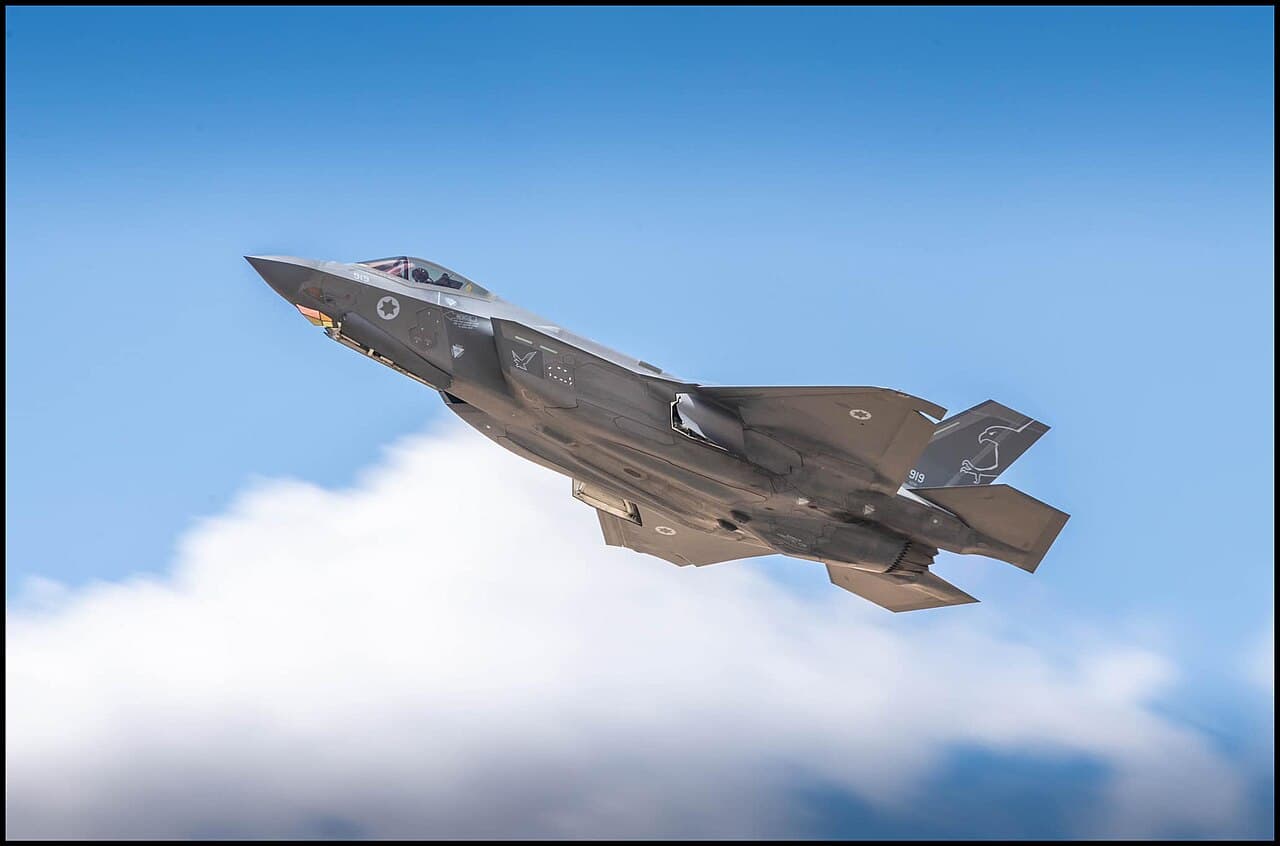
Air-delivered: Israeli Air Force F-15I Ra'am and F-35I Adir fighters are believed to be nuclear-capable, able to deliver gravity bombs.
Israel also possesses advanced missile technology through its space launch vehicle program (Shavit), demonstrating ICBM-range capability.
Why Ambiguity Matters More Under Direct War Pressure
Opacity is easiest to maintain in peacetime. Under direct confrontation with Iran and proxy pressure from Hezbollah, the policy comes under unusual strain.
- Some Israeli analysts argue ambiguity should become more visible to sharpen deterrence.
- Others argue any overt signaling would validate regional proliferation arguments and narrow diplomatic flexibility.
- That means Israel's deterrent debate is not only about weapons. It is about how much strategic uncertainty is useful and when it becomes a liability.
Military Overview
| Metric | Value |
|---|---|
| GFP Rank | #15 of 145 |
| GFP Score | 0.3757 |
| Active military | 170,000 |
| Reserve forces | 465,000 |
| Military budget | $24 billion |
Despite its small size, Israel fields one of the most technologically advanced militaries in the world. The Israel Defense Forces (IDF) operate F-35I stealth fighters, the Iron Dome and Arrow missile defense systems, and the Merkava main battle tank. Israel's mandatory military service creates a large trained reserve force.
Role in Current Nuclear Risk
Israel is at the epicenter of the current nuclear crisis:
- Iran conflict: The Israel-Iran military confrontation is the primary driver of the current Doomsday Clock escalation. Israel has conducted strikes against Iranian nuclear facilities and military targets, and faces retaliatory attacks from Iran and its proxies.
- Nuclear ambiguity under pressure: As the Iran crisis intensifies, Israel's undeclared nuclear arsenal takes on renewed strategic significance. Some analysts argue the crisis could force Israel toward nuclear signaling.
- Regional escalation: Israel's conflicts with Hezbollah, Hamas, and Iran-backed militias create multiple escalation pathways that could involve nuclear considerations.
- US alliance: Israel's close alliance with the United States, including US military support during Operation Epic Fury, links Israeli security directly to the US nuclear umbrella and Middle East force posture.
Israel's Role in Operation Epic Fury
Israel was the only partner nation in the opening strikes against Iran, contributing intelligence, aircraft, and targeting data to the joint operation. The Israeli Air Force's F-35I Adir stealth fighters participated in strikes on Iranian air defense networks, while Israeli intelligence provided real-time targeting support for the nuclear facility strikes at Fordow and Natanz.
Two-front war: The activation of Hezbollah's arsenal forced Israel into a simultaneous two-front conflict. Hezbollah launched over 1,000 rockets and missiles into northern Israel within the first three days, including precision-guided munitions that struck as far south as Haifa. The Galilee region was evacuated, and Iron Dome and David's Sling missile defense systems were pushed to operational limits — intercepting the majority of threats but allowing several to penetrate. IDF ground forces launched cross-border raids into southern Lebanon to destroy launch sites within 5 km of the border.
Nuclear ambiguity under strain: The Iran crisis has created unprecedented pressure on Israel's policy of deliberate nuclear ambiguity. Some Israeli security commentators argue that the scale of the Iranian and Hezbollah response justifies nuclear signaling — making Israel's arsenal more visible to deter further escalation. Others counter that any move toward nuclear transparency would accelerate regional proliferation by confirming what Arab states have long suspected and giving them justification to pursue their own programs.
Strategic dependency: Israel's participation in Operation Epic Fury deepens its dependency on US military support. The IDF relies on American ammunition resupply, intelligence sharing, and the US military's broader regional force posture to deter Iranian allies beyond Hezbollah. This dependency gives Washington significant leverage over Israeli decision-making — but also means that any US de-escalation with Iran must account for Israeli security requirements.
Domestic politics: The operation has generated near-unanimous support in the Israeli Knesset. The destruction of Iran's nuclear facilities fulfills a decades-long Israeli strategic objective. However, the cost — sustained Hezbollah bombardment of Israeli cities, civilian casualties, and the prospect of a prolonged northern front — has prompted criticism from opposition lawmakers who argue the government had no plan for the Hezbollah dimension of the conflict.
What To Watch Next
For readers using this page as a standing reference, the highest-signal questions are:
- whether Israeli nuclear ambiguity remains stable under prolonged Iran confrontation,
- whether Hezbollah pressure changes how Israel thinks about survivability and second-strike signaling,
- whether US support deepens Israeli dependence or broadens Israeli operational freedom,
- and whether a direct Iran-Israel military cycle pushes more regional actors to use Israel's undeclared arsenal as justification for their own nuclear hedging.
Related Articles
Iran vs Israel Military Power: A Complete 2026 Comparison
Iran vs Israel military comparison across manpower, airpower, missile inventories, defense spending, and the nuclear deterrence balance in 2026.
Trump Vows More Iran Strikes as US Expands Mideast Forces
President Trump pledged additional strikes while the Pentagon confirmed roughly 50,000 US personnel and major naval-air assets deployed across the region.

Is This Like the Cuban Missile Crisis? Comparing 1962 and 2026
A 1962 vs 2026 comparison of decision windows, nuclear proximity, escalation control, and why the Iran crisis is framed as a modern Cuban Missile moment.
Trump Says 'Too Late' for Iran Talks as Israel Hits Tehran
On Day 4 of Operation Epic Fury, Trump rejected renewed talks as Israeli strikes hit Tehran, oil rose, and global markets reacted to widening conflict risk.
Russia vs US Nuclear Forces: 2026 Strategic Comparison
Russia and US nuclear forces compared by warheads, delivery systems, modernization, spending, and doctrine across the world's two largest arsenals.
What Would Happen If Nuclear War Started? A Step-by-Step Guide
What happens if nuclear war starts? From first launch to nuclear winter: blast zones, fallout, infrastructure collapse, and long-term survival risks.