Trump Vows More Iran Strikes as US Expands Mideast Forces
President Trump pledged additional strikes while the Pentagon confirmed roughly 50,000 US personnel and major naval-air assets deployed across the region.
Staff Reporting and Analysis. Produces source-backed reporting, explainers, and reference pages on nuclear risk, proliferation, and escalation dynamics.
Key Sources
Start with the strongest supporting documents and reporting behind this page.
Country Profiles Mentioned
Open the profile pages for the countries referenced directly in this article.
Related Rivalries
These comparison pages help place this article inside the broader balance of power and rivalry structure.
Rivalry
Is This Like the Cuban Missile Crisis? Comparing 1962 and 2026
A 1962 vs 2026 comparison of decision windows, nuclear proximity, escalation control, and why the Iran crisis is framed as a modern Cuban Missile moment.
2026-03-03
Rivalry
Iran War vs Iraq War: How the 2026 and 2003 Conflicts Compare
Iran 2026 vs Iraq 2003 compared across legal authority, coalition structure, force design, economic shock, and the central role of nuclear risk.
2026-03-03
Rivalry
Iran Crisis 2026 vs 2019 Tensions: What's Different This Time
How the 2026 Iran crisis differs from 2019: leadership decapitation, larger retaliation, Hormuz closure risk, and a sharper nuclear escalation path.
2026-03-03
Related Doctrines
These explainers provide the strategic concepts behind the escalation, deterrence, and risk logic discussed here.
Doctrine
What Is the Strait of Hormuz?
What is the Strait of Hormuz? A practical explainer on its geography, oil-flow importance, military vulnerability, and global economic consequences of closure.
2026-03-03
Doctrine
What Is Mutually Assured Destruction (MAD)?
What is mutually assured destruction (MAD)? We explain the doctrine, Cold War logic, modern criticisms, and why MAD still shapes nuclear strategy.
2026-03-03
Doctrine
What Is Escalation Dominance?
Escalation dominance is the ability to control each rung of conflict and impose higher costs on an adversary. This explains why it drives crisis strategy.
2026-03-04
Trump promises more strikes on Iran as U.S. adds to forces in the Mideast, with President Trump vowing on Day 3 of Operation Epic Fury that the campaign will continue "until all objectives are achieved" — even as six American service members have been killed and the Pentagon confirms a force of ~50,000 troops now assembled across the Persian Gulf region. Secretary of State Marco Rubio reinforced the message bluntly: "The hardest hits are yet to come."
Operation Epic Fury: What Has Been Struck
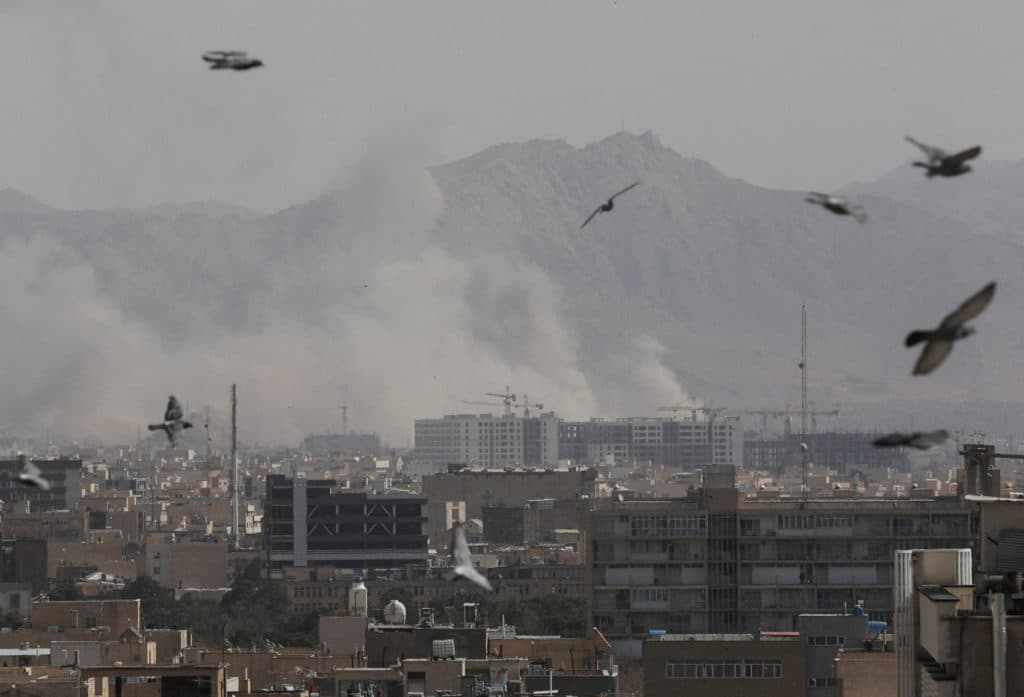
The joint U.S.-Israeli military operation launched in the early hours of Saturday, February 28, 2026, striking at least nine cities across Iran simultaneously. In the first 48 hours alone, the United States and Israel hit over 1,250 targets, according to military officials cited by NBC News.
Confirmed or reported strike locations span Iran's military and nuclear infrastructure:
- Tehran — IRGC headquarters, government ministries, intelligence facilities, state television buildings, the compound of Supreme Leader Ali Khamenei's office, and the Iran Atomic Energy Agency headquarters
- Isfahan — nuclear complex, ballistic missile production and storage sites
- Parchin — explosive research testing facility linked to nuclear weapons development
- Qom — IRGC command infrastructure
- Karaj, Kermanshah, Lorestan, Tabriz — regional military installations, Basij paramilitary bases, and communications nodes
B-2 Spirit stealth bombers operating from Diego Garcia deployed 2,000-pound precision-guided ordnance against hardened ballistic missile facilities, according to Military.com. MQ-9 Reaper drones and F-35 fighter jets have also been employed throughout the campaign. Iran's navy has been a central target: Trump claimed nine Iranian warships were sunk and the Iranian naval headquarters was "largely destroyed."
Nuclear risk analysts at CSIS have noted that while strikes at Parchin and Isfahan represent significant blows to Iran's nuclear weapons research infrastructure, the full extent of damage to Iran's enrichment capability — particularly at deeply buried Fordow — remains uncertain.
Trump's Promise of Heavier Strikes
On March 1, President Trump addressed the nation and the world in a video statement, pledging that Operation Epic Fury would not be curtailed by early casualties or international pressure:
"We will continue these strikes until all objectives are achieved. Iran will face a force that has never been seen before if they continue to resist."
"This was our last, best chance to strike…and eliminate the intolerable threats posed by this sick and sinister regime."
Trump projected a timeline of four to five weeks for the operation, while immediately undercutting that ceiling: "We have the capability to go far longer than that." He acknowledged that more American deaths were likely — "There will likely be more before it ends" — while calling on Iranians to rise up against their government: "To the Iranian patriots: seize this moment. Take back your country."
The language of regime change was explicit. Trump's stated objectives for Operation Epic Fury, as outlined in his address, are:
- Preventing Iran from acquiring a nuclear weapon
- Destroying Iran's ballistic missile arsenal and production sites
- Degrading Iran's proxy network (Hezbollah, Hamas, Houthis, Iraqi militias)
- Annihilating Iran's navy
- Facilitating regime change from within
The open-ended framing — "go far longer" with no defined off-ramp — is the detail most concerning to nuclear risk analysts and congressional critics alike, as reported by NPR.
U.S. Military Buildup in the Mideast
As Trump promises more strikes on Iran, the U.S. continues adding to its forces in the Mideast at a scale not seen since the 2003 Iraq War. The Pentagon's confirmed force posture as of March 2, 2026:
| Asset | Detail |
|---|---|
| Total US personnel | ~50,000 across the Gulf region |
| Aircraft carrier strike groups | Two — Persian Gulf and Arabian Sea |
| Combat aircraft | 120+ including B-2s, F-35s, F-15Es |
| Missile defense | THAAD and Patriot batteries at allied bases |
| Strike systems | HIMARS launchers at multiple forward locations |
| Bombers | B-2 Spirits operating from Diego Garcia |
Defense Secretary Pete Hegseth confirmed there are currently no US ground troops inside Iran, but was explicit that he "would not rule out" future deployment: the US "would go as far as we need to go," he said, per CBS News. He also offered a firm historical contrast: "This is not Iraq. This is not endless."
Joint Chiefs Chairman General Caine described the opening of the campaign as a "single synchronized wave" constituting a "massive overwhelming attack." The force structure in place — two carrier groups, advanced ground-based missile defense, and stealth bomber capability — is consistent with preparation for a sustained air campaign rather than a limited punitive strike.
Casualties: Americans Killed and Wounded
Day 3 of the conflict brought the confirmed U.S. death toll to six service members, with 18 others seriously wounded, according to NBC News and CBS News.
Four of the six killed died at a tactical operations center in Kuwait that was struck by an Iranian drone attack. Military officials reviewing the incident have questioned the adequacy of fortifications at the facility — a triple-wide trailer protected by only 12-foot concrete T-walls, offering insufficient protection against aerial drone strikes.
Two additional U.S. Defense Department personnel were injured in a separate drone attack on a hotel in Bahrain. On the air operations side, three American F-15E Strike Eagles were mistakenly shot down by Kuwaiti air defenses over Kuwait in a friendly fire incident; all six pilots ejected safely, US officials confirmed.
On the Iranian side, the death toll is staggering: the Iranian Red Crescent reported approximately 555 killed as of March 2, with the total rumored to be significantly higher. At least 49 senior regime officials were killed in targeted strikes, including Supreme Leader Ali Khamenei himself, who was killed on February 28 in a coordinated strike on his compound — see our full coverage: Iran Confirms Supreme Leader Khamenei Killed in US-Israeli Strikes.
Civilian casualties are also substantial. Al Jazeera reported at least 201 civilians killed and 747 wounded within Iran; at least 11 killed in Israel from Iranian retaliatory strikes; and additional deaths in Kuwait (1), UAE (3), and Iraq (2) from regional spillover.
Secretary Rubio: "The Hardest Hits Are Yet to Come"
The Trump administration's messaging on escalation has been coordinated and deliberately intimidating. Secretary of State Marco Rubio delivered what amounted to a formal warning to Iran and any observers hoping the conflict would de-escalate:
"The hardest hits are yet to come from the U.S. military. The next phase will be even more punishing."
The statement confirmed that the current phase of the campaign — destructive as it has been — is not the ceiling of US intent. Rubio's framing tracks with the White House's internal logic: by describing current operations as preliminary to something worse, the administration is simultaneously pressure-testing Iran's will to retaliate and signaling to domestic audiences that the operation is succeeding on a defined trajectory.
General Caine echoed this posture, describing the campaign's design as one built for sustained impact rather than a single overwhelming blow, despite his initial characterization of the opening wave as "massive." The distinction matters for nuclear risk assessment: a sustained, escalating campaign against a nuclear-threshold state is categorically different from a short, sharp punitive action.
Iran's Retaliation: Missiles, Drones, and Embassy Attacks
Iran has responded with a broad, multi-vector retaliation campaign targeting US interests and allies across the region, as covered in depth in our article on Iran's Retaliatory Strikes on US Bases in the Persian Gulf.
Key retaliatory actions confirmed as of March 2:
- USS Abraham Lincoln — Iran launched ballistic missiles at the aircraft carrier operating in the region; US officials reported no damage, with the missile defense systems successfully intercepting the threat
- US Embassy in Riyadh — struck by two drones; limited structural damage, no confirmed American casualties
- US Embassy in Amman, Jordan — evacuated following a credible threat
- Gulf military bases — drone and missile strikes targeting US facilities in Qatar, Kuwait, UAE, Bahrain, and Iraq
- Saudi Ras Tanura refinery — struck by drones, triggering a brief halt in production
- Strait of Hormuz shipping — multiple commercial vessels targeted, raising concerns about sustained disruption to the waterway through which approximately 20% of global oil supply passes
Iran's outgoing President Pezeshkian — operating in the power vacuum left by Khamenei's death — vowed Iran "will not remain silent" and promised a response proportional to what Iran has suffered. The government has not signaled any interest in ceasefire negotiations as of this writing.
Regional Fallout: Embassies, Energy, and Flights
The wider regional impact of Operation Epic Fury is accelerating. The U.S. State Department has issued an urgent advisory urging all American citizens in 14 Middle Eastern countries to depart immediately, citing the unpredictable spread of Iranian retaliation and its proxy network attacks, per NBC News.
Energy markets are in turmoil:
- Qatar has halted liquefied natural gas (LNG) production, affecting global LNG supply
- The Saudi Ras Tanura refinery attack has raised fears of broader Gulf oil infrastructure vulnerability
- Strait of Hormuz commercial shipping is disrupted
- US domestic gasoline prices are projected to rise 20–30 cents per gallon by the end of the week, according to CBS News analysts
Aviation has been severely disrupted: thousands of flights have been cancelled across the region, multiple countries have closed their airspace to commercial traffic, and hundreds of thousands of passengers are stranded globally.
Diplomatic relationships are straining: Italy and France both reported they were not notified of the strikes in advance — a significant breach in alliance communication norms that has prompted sharp reactions in European capitals. Negotiators from Oman, who had been facilitating US-Iran nuclear talks, stated that those talks were "showing progress" before the strikes began — directly contradicting Trump's characterization of the diplomatic track as having failed.
Congressional Pushback: War Powers and No AUMF
The constitutional dimension of the conflict is developing into a serious secondary crisis. Operation Epic Fury was launched without Congress authorizing or even being formally consulted in advance. There is no Authorization for Use of Military Force (AUMF) covering the strikes on Iran:
- The War Powers Resolution requires the President to notify Congress within 48 hours of deploying forces into hostilities and limits operations to 60 days without authorization
- The administration has not specified which legal authority — if any — it believes authorizes the operation
- Debate continues over whether the 2002 Iraq AUMF or 2001 AUMF (targeting Al-Qaeda) could be stretched to cover Iran strikes
Congressional responses have been swift but face uncertain prospects:
- Sen. Mark Warner (D-VA): "There was no imminent threat" to the United States. He called the operation a "war of choice" with an unclear exit strategy and shifting goals.
- House Speaker Mike Johnson: Defended the preemptive strikes, arguing Israel would have acted "with or without" US support, framing US participation as necessary to control escalation.
- Rep. Thomas Massie (R-KY): Filed a war powers resolution demanding Congressional authorization.
- Sen. Rand Paul (R-KY): Filed a war powers resolution; among the most vocal Republican critics of the operation.
- Rep. Ro Khanna (D-CA): Co-sponsored war powers challenge alongside Massie in a rare bipartisan alliance.
Bloomberg's reporting on the administration's internal deliberations reveals a rapid pivot from diplomacy: senior officials shifted from nuclear negotiation track to strike authorization in a compressed window, with the final go-order given by Trump at 3:38 p.m. on Friday, February 27.
The Domestic and Strategic Pressure Points
The key issue is not just that Trump promised more strikes. It is that every additional day of operations increases pressure across several systems at once:
- war powers and legality,
- coalition coordination and force protection,
- oil-price and market stress,
- and the possibility that Iran's surviving leadership draws harder conclusions about regime survival and nuclear deterrence.
The Axios analysis of the MAGA divide is useful here not as social commentary but as a signal that the administration may face rising domestic political costs even while the operational campaign intensifies. That combination often narrows policy flexibility rather than expanding it.
What Comes Next
As Trump promises more strikes on Iran and the U.S. continues adding to its forces in the Mideast, the conflict trajectory is deeply uncertain. Key developments to watch:
- Phase 2 targeting — Rubio's warning of "harder hits" suggests Phase 1 targeted infrastructure while Phase 2 may focus on leadership, regime support structures, or remaining nuclear sites including Fordow
- Congressional authorization — whether War Powers Resolution challenges gain enough support in either chamber to constrain the operation
- Allied participation — will any NATO member or Gulf state join the coalition beyond Israel?
- Iran's nuclear calculation — as CSIS analysts have noted, the destruction of conventional deterrents may accelerate any remaining Iranian decision to pursue a nuclear weapon as the only surviving guarantee of regime survival
- Ground troop decision — Hegseth's refusal to rule out boots on the ground is the single variable most capable of transforming this from an air campaign into a sustained occupation
- Strait of Hormuz — continued attacks on Gulf energy infrastructure could trigger a global recession-level oil price shock
For deeper context on how this conflict affects the Doomsday Clock and nuclear risk levels, see our Nuclear Threat Assessment: Iran Crisis — What Happens Next and our explainer on how nuclear deterrence works.