
Iran vs Israel Military Power: A Complete 2026 Comparison
Iran vs Israel military comparison across manpower, airpower, missile inventories, defense spending, and the nuclear deterrence balance in 2026.
Staff Reporting and Analysis. Produces source-backed reporting, explainers, and reference pages on nuclear risk, proliferation, and escalation dynamics.
Key Sources
Start with the strongest supporting documents and reporting behind this page.
Profiles In This Comparison
Open the country profiles for the states referenced in this comparison to see stockpiles, force structure, and doctrine in more detail.
Related Rivalries
These comparison pages help place this article inside the broader balance of power and rivalry structure.
Rivalry
US Military vs Iran Military: A Complete 2026 Comparison
US vs Iran military comparison across personnel, air and naval power, missiles, budgets, and how asymmetry shapes escalation outcomes in 2026.
2026-03-03
Rivalry
Is This Like the Cuban Missile Crisis? Comparing 1962 and 2026
A 1962 vs 2026 comparison of decision windows, nuclear proximity, escalation control, and why the Iran crisis is framed as a modern Cuban Missile moment.
2026-03-03
Rivalry
Iran Crisis 2026 vs 2019 Tensions: What's Different This Time
How the 2026 Iran crisis differs from 2019: leadership decapitation, larger retaliation, Hormuz closure risk, and a sharper nuclear escalation path.
2026-03-03
Related Doctrines
These explainers provide the strategic concepts behind the escalation, deterrence, and risk logic discussed here.
Doctrine
What Is Escalation Dominance?
Escalation dominance is the ability to control each rung of conflict and impose higher costs on an adversary. This explains why it drives crisis strategy.
2026-03-04
Doctrine
What Happens If Iran Gets Nuclear Weapons?
If Iran obtained nuclear weapons, effects could include regional arms races, Israeli strike pressure, oil-market shocks, and broader nonproliferation fallout.
2026-03-03
Doctrine
What Is Mutually Assured Destruction (MAD)?
What is mutually assured destruction (MAD)? We explain the doctrine, Cold War logic, modern criticisms, and why MAD still shapes nuclear strategy.
2026-03-03
Iran vs Israel military power is one of the defining rivalries of the modern Middle East — two nations separated by more than 1,000 kilometers who have never fought a direct conventional war, yet have spent decades locked in a shadow conflict of proxy armies, missile strikes, assassination campaigns, and intelligence operations. With the Iran-Israel conflict reaching an acute kinetic phase in early 2026, understanding exactly how these two militaries compare has never been more relevant.
Summary: Iran vs Israel military power is defined by a fundamental asymmetry: Iran holds overwhelming numerical advantages in personnel, tanks, artillery, and missiles, while Israel possesses decisive technological superiority, a $34.6 billion defense budget, and the most advanced multi-layered air defense system in the world. In a direct conflict, most defense analysts assess Israel as the operationally superior force — but Iran's missile arsenal, vast submarine fleet, and sprawling proxy network across four countries make it a formidable and unpredictable adversary.
Overall Military Rankings: How the World Rates Both Forces
The most widely cited independent military ranking system, Global Firepower, assigns each nation a Power Index score — where a lower score indicates a stronger military force. As of 2026:
| Metric | Israel | Iran |
|---|---|---|
| GFP Power Index | 0.2707 | 0.3199 |
| Global Rank | #15 of 145 | #16 of 145 |
Israel edges out Iran on the overall Power Index despite having a population nine times smaller and a land area 75 times smaller. This tells the essential story of Iran vs Israel military power: Iran compensates for technological shortfalls with sheer mass; Israel compensates for demographic limitations with precision, technology, and US backing.
Manpower & Personnel: Iran's Enormous Numerical Advantage
No comparison of Iran vs Israel military power can ignore the demographic gap. Iran has a population of approximately 88 million — nearly nine times larger than Israel's 9.4 million. That translates directly into available military manpower:
| Category | Israel | Iran |
|---|---|---|
| Active Personnel | 169,500 | 610,000 |
| Reserve Personnel | 465,000 | 350,000 |
| Paramilitary | 35,000 | 220,000 |
| Available Manpower | 3.9 million | 49.5 million |
Iran's active military is 3.6 times larger than Israel's. However, the reserve comparison is more nuanced: Israel maintains 465,000 reservists — more than Iran — because Israel's mandatory conscription system (three years for men, two for women) keeps a large trained reserve pool constantly cycled and combat-ready. According to War Power Israel, Israel's reserve force is considered highly professional despite its relatively small numbers.
Iran's paramilitary forces — dominated by the Islamic Revolutionary Guard Corps (IRGC) Basij militia, with approximately 220,000 personnel — add another layer of internal security and wartime mobilization capacity. The Basij served as human wave infantry during the Iran-Iraq War and remain a key component of Iran's domestic security architecture.
Air Power: Where Israel Wins Decisively
The most consequential gap in Iran vs Israel military power is in the air. Israel's air force is widely regarded as the most capable in the Middle East — and the qualitative gap with Iran is enormous.
| Category | Israel | Iran |
|---|---|---|
| Total Aircraft | 597 | 551 |
| Fighter Aircraft | 239 | 188 |
| Attack Aircraft | 45 | 21 |
| Attack Helicopters | 48 | 13 |
| Aerial Tankers | 13 | 6 |
| Special Mission Aircraft | 19 | 10 |
Source: Global Firepower 2026
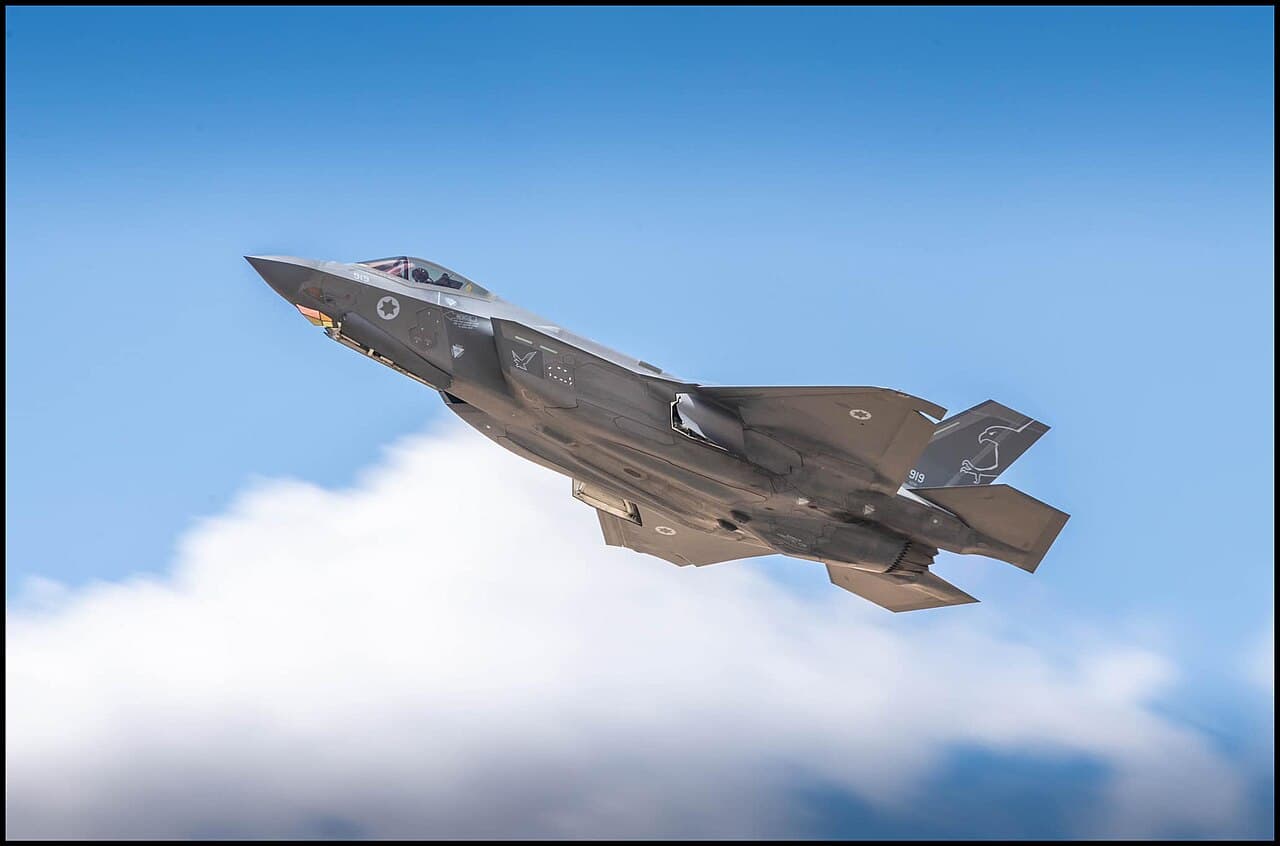
But the raw numbers vastly undersell Israel's advantage. Israel operates F-35I Adir stealth fighters — a domestically modified variant of the Lockheed Martin F-35 with Israeli-specific avionics, electronic warfare systems, and weapons integration. It also flies advanced F-15I Ra'am and F-16I Sufa aircraft equipped with modern precision munitions and long-range strike capability.
Iran, by contrast, relies on a fleet of aging aircraft acquired before 1979 — primarily F-4 Phantoms, F-5 Tigers, and F-14 Tomcats purchased from the United States under the Shah — supplemented by a small number of Soviet-era MiG-29s and Sukhoi-24s. The International Institute for Strategic Studies has reported that Iran's conventional armed forces "struggle with an increasingly obsolescent equipment inventory," according to CBC News.
The verdict from defense analysts is unambiguous. Shaan Shaikh of the Center for Strategic and International Studies told CBC: "Israel certainly has more sophisticated military technology than Iran. They have the latest aircraft, armed with modern missiles and bombs."
Israel also has 13 aerial tankers (vs Iran's 6), giving Israeli aircraft the refueling capability needed to strike targets at the range of Iran's territory — a capability Israel has already demonstrated in strikes on Iranian proxy infrastructure and, according to multiple reports, Iranian nuclear facilities.
Land Power: Iran's Domain
On the ground, the Iran vs Israel military power equation reverses sharply in Iran's favor. Iran fields a massive conventional land force built around quantity, long-range artillery, and rocket systems.
| Category | Israel | Iran |
|---|---|---|
| Main Battle Tanks | 1,300 | 2,675 |
| Armored Vehicles | 62,380 | 75,939 |
| Self-Propelled Artillery | 323 | 424 |
| Towed Artillery | 171 | 1,803 |
| Rocket Projectors | 228 | 1,550 |
Source: Global Firepower 2026
Iran has twice as many tanks as Israel, more than ten times the towed artillery, and nearly seven times the rocket projector inventory. Iran's rocket projector fleet — ranked #4 in the world — is particularly significant: these systems can saturate targets with rocket fire in ways that overwhelm conventional defenses.
Israel's qualitative edge reasserts itself even in land power, however. The Israeli Merkava Mk. IV is one of the most advanced battle tanks in the world, featuring a rear-exit crew compartment, advanced composite armor, and the Trophy active protection system (APS) that intercepts incoming anti-tank missiles in flight. Iranian armor includes aging T-54/T-55 and T-72 variants, with a domestically produced Karrar tank of uncertain capability.
The land comparison is also largely academic given the geography: the two countries share no border and are separated by Iraq, Syria, Jordan, and/or Saudi Arabia depending on the route. A conventional ground invasion by either side would require crossing two to three sovereign states and thousands of kilometers — effectively impossible without a regional coalition war.
Naval Power: Iran's Submarine Fleet Is a Wild Card
Iran's naval posture in the Persian Gulf and Strait of Hormuz represents one of its most significant strategic levers in any Iran vs Israel military power comparison.
| Category | Israel | Iran |
|---|---|---|
| Total Fleet | 82 | 109 |
| Submarines | 6 | 25 |
| Frigates | 0 | 7 |
| Corvettes | 7 | 3 |
| Patrol Vessels | 66 | 21 |
Source: Global Firepower 2026
Iran's submarine fleet — 25 vessels, ranked #3 in the world — is disproportionately large for a regional power. Most are Ghadir-class and Nahang-class midget submarines designed for littoral (shallow coastal) operations in the Persian Gulf rather than blue-water fleet confrontations. Nevertheless, these submarines give Iran the ability to lay mines, conduct ambushes on tanker traffic, and complicate any naval operation in the Gulf.
Iran also controls the Strait of Hormuz — the 33-kilometer-wide chokepoint through which approximately 20% of the world's oil supply transits daily. The ability to threaten or close this strait is Iran's most powerful economic weapon, capable of triggering global oil price crises without firing a single missile at Israel directly.
Israel's naval strength centers on its Sa'ar-class corvettes equipped with advanced anti-ship missiles, a small fleet of Dolphin-class submarines (believed to be nuclear-capable), and a large coastal patrol force. Israel has no frigates or destroyers — its navy is built around coastal defense and littoral strike, not blue-water power projection.
Defense Spending: Israel's Financial Superiority
The defense budget comparison in Iran vs Israel military power is stark — and goes a long way toward explaining Israel's qualitative advantages.
| Metric | Israel | Iran |
|---|---|---|
| Defense Budget | $34.6 billion (Rank #18) | $9.23 billion (Rank #36) |
| Foreign Reserves | $214.5 billion | $120.6 billion |
| Purchasing Power (GDP PPP) | $472 billion | $1.49 trillion |
Source: Global Firepower 2026
Israel outspends Iran on defense by nearly 4:1 — $34.6 billion to $9.23 billion. This gap is compounded by approximately $3.8 billion per year in US military assistance, which gives Israel priority access to America's most advanced weapons systems including the F-35, advanced air-to-air missiles, and precision-guided munitions.
Iran's defense spending has been severely constrained by decades of international sanctions targeting its nuclear program and regional destabilization activities. According to CBC News, sanctions have "significantly hampered Iran's access to cutting-edge military equipment" — which explains why Iranian fighter jets are 40-50 years old while Israel deploys fifth-generation stealth aircraft.
Iran's advantage in purchasing power parity ($1.49T vs $472B) reflects its larger economy in absolute terms — but that GDP is split across a population nine times larger, and much of it is under sanction restrictions that prevent converting economic output into military hardware.
Missile Arsenal and Air Defense: The Most Critical Dimension
In any realistic Iran vs Israel military power conflict scenario, missiles and air defenses would be the decisive domain. Neither country can easily deploy ground forces against the other — everything comes down to what can be struck from the air and what can be intercepted.
Iran's Missile Arsenal
Iran possesses the largest and most diverse ballistic and cruise missile arsenal in the Middle East, with thousands of missiles across multiple platforms:
- Shahab-3: Iran's primary medium-range ballistic missile, range 1,300+ km, capable of reaching all of Israel
- Emad: Precision-guided MRBM with maneuvering reentry vehicle
- Khorramshahr: Advanced MRBM with range up to 2,000 km and a reported accuracy of 30 meters
- Zolfaghar: Short-range ballistic missile, extensively used by Houthi proxies
- Fateh-110 family: Short-range precision ballistic missiles, with highly accurate variants
- Shahed-136 drones: One-way attack drones (used extensively in Ukraine), produced by the thousands
Iran demonstrated this arsenal in two direct strikes on Israeli territory in 2024 — the April attack involving 300+ drones and missiles, and the October follow-up with approximately 180 ballistic missiles. The scale revealed both Iran's genuine strike capability and Israel's air defense effectiveness.
Israel's Multi-Layer Air Defense
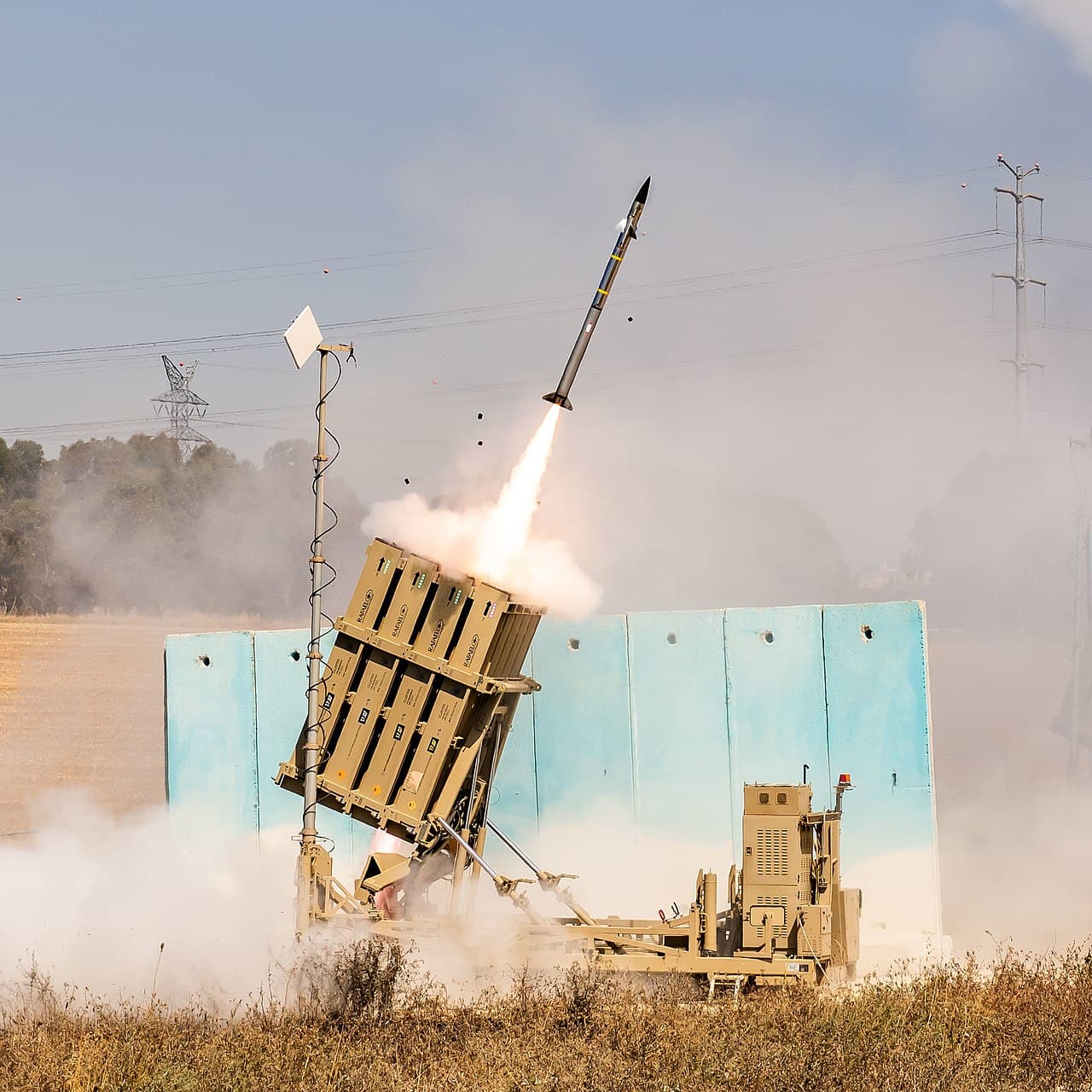
Israel has built the most comprehensive layered air defense system in the world, specifically designed to intercept threats from Iran and its proxies:
| System | Role | Range |
|---|---|---|
| Iron Dome | Short-range rockets and mortars | Up to 70 km |
| David's Sling | Medium-range ballistic & cruise missiles | 40–300 km |
| Arrow-2 | Long-range ballistic missiles (atmosphere) | 90+ km |
| Arrow-3 | Long-range ballistic missiles (exo-atmosphere) | 2,400+ km altitude |
This layered architecture means that Iranian missiles face successive intercept opportunities at multiple altitudes. CBC News notes that Israel's defense "offers less comprehensive coverage than Israel's multi-layered approach" — Iran's S-300 systems primarily protect specific strategic sites like nuclear facilities, not entire cities.
Iran does reportedly operate Russian S-300 air defense systems and possibly one S-400 battery, primarily positioned around nuclear facilities at Fordow, Isfahan, and Natanz. These are capable systems — but they protect fixed sites, not Iran's broader airspace.
Iran's Proxy Network: The Asymmetric Multiplier
Any accurate comparison of Iran vs Israel military power must account for Iran's most potent force multiplier: its extensive proxy network across the region.
- Hezbollah (Lebanon): ~150,000 rockets and missiles, estimated 40,000–50,000 fighters, positioned on Israel's northern border
- Hamas (Gaza): Tens of thousands of fighters, tunnel networks, rocket manufacturing capacity
- Houthis (Yemen): Long-range ballistic missiles reaching Israel (demonstrated), anti-ship missiles threatening Red Sea shipping
- Iraqi militias: Multiple Iran-aligned factions with rockets, drones, and anti-armor capabilities
This proxy network allows Iran to put military pressure on Israel from four directions simultaneously — Lebanon, Gaza, Yemen, and Iraq — without deploying a single Iranian soldier into direct combat. The approach has historically "spared Iran from direct conflict consequences," as CBC reports.
Afshon Ostovar, Associate Professor of National Security at the Naval Postgraduate School, offers a blunt assessment: Iran "can destroy stuff. It can kill people. But it can't win" in a direct conventional confrontation with Israel. The proxy network exists precisely because Iran knows this — it enables Iran to impose costs on Israel without triggering the kind of direct war Iran would lose.
The Nuclear Dimension
No discussion of Iran vs Israel military power is complete without addressing nuclear capabilities — the variable that transforms everything.
Israel is widely believed to possess approximately 90 nuclear warheads, based on assessments from the Stockholm International Peace Research Institute (SIPRI). Israel maintains a policy of deliberate ambiguity, neither confirming nor denying nuclear capability. Its Dolphin-class submarines are believed to provide a sea-based second-strike capability.
Iran does not possess nuclear weapons but has been assessed at near-threshold status. As of early 2026, Iran had enriched uranium to approximately 60% purity — below the ~90% needed for weapons-grade material, but far above the 3.67% permitted under the 2015 JCPOA. The International Atomic Energy Agency has estimated Iran could produce enough fissile material for a warhead in as little as a week if it chose to enrich to weapons grade.
This nuclear asymmetry fundamentally shapes the Iran vs Israel military power calculation. Israel's nuclear arsenal provides the ultimate deterrent against an existential threat — while Iran's near-threshold status creates an ongoing source of regional tension and is the underlying driver of the current crisis. See our full nuclear threat assessment for detailed escalation scenarios.
Beyond The Numbers: Why Israel Still Rates Higher
Raw inventories can make the matchup look close. The harder question is what happens once those inventories are used under combat conditions.
Israel's edge rests on factors that simple tables do not show well:
- integrated airpower and missile defense,
- higher readiness for precision strike missions,
- shorter command loops and faster battle management,
- and a military culture built around repeated high-intensity activation.
Iran's edge, by contrast, lies in scale, dispersion, missile volume, and its ability to turn a bilateral confrontation into a multi-front regional problem. That is why the most accurate conclusion is not "Israel is stronger" in the abstract. It is that Israel is the more capable direct-force military, while Iran is the more dangerous escalation generator.
Geographic and Strategic Factors
Geography plays a crucial role in understanding Iran vs Israel military power in practice:
- Distance: Iran and Israel are separated by 1,000–1,500 km depending on the route. They share no border.
- Conflict type: Any direct Iran-Israel conflict would rely almost entirely on air strikes, ballistic missiles, and drone attacks — not ground invasion.
- Israel's vulnerability: Israel's small land area (22,000 km² — roughly the size of New Jersey) means that saturation missile and drone attacks could overwhelm even the best air defense systems.
- Iran's depth: Iran's massive territory (1.65 million km²) provides strategic depth — it can absorb strikes and disperse military assets across a vast area.
- Strait of Hormuz: Iran's control of this chokepoint gives it economic leverage far exceeding its direct military capabilities.
Iran has 177 serviceable airports across its territory (vs Israel's 40), a 223,485 km road network (vs 20,391 km), and a far larger logistics and infrastructure base — all relevant in a sustained conflict. Israel's geographic compactness is both its greatest vulnerability and the reason it has invested so heavily in air defense.
Expert Verdict: Who Would Win?
The consensus across the sources reviewed for this analysis — Global Firepower, CBC News, Encyclopaedia Britannica, and War Power Israel — consistently reaches the same conclusion:
In a direct, conventional military confrontation, Israel would be the superior force.
The reasons are consistent across every analysis:
- Technological supremacy: Israel's air force, precision weapons, and C4ISR (command, control, communications, computers, intelligence, surveillance, and reconnaissance) systems are generations ahead of Iran's.
- US backing: Access to American weapons, intelligence, and logistical support gives Israel a strategic backstop no other regional military enjoys.
- Combat experience: Israel's military has been in continuous operational engagement since 1948. Its doctrine, training, and institutional knowledge reflect real-world lessons.
- Defense architecture: The Iron Dome / David's Sling / Arrow system is the most capable territorial air defense network in the world.
- Nuclear deterrence: Israel's presumed nuclear arsenal provides the ultimate backstop against existential threats.
But the question of "who would win" depends entirely on what "winning" means. Iran cannot win a direct war with Israel — but it doesn't need to. Iran's strategy, as Ostovar told CBC, is to impose costs through proxies, missiles, and economic disruption without ever triggering a war it would lose. That strategy has proven remarkably durable for 40+ years.
The current crisis has tested those assumptions in ways neither side had fully anticipated.