Doomsday Clock History: Every Setting From 1947 to 2025
Doomsday Clock history year by year: from 7 minutes to midnight in 1947 to 89 seconds in 2025. Full timeline of every setting, what changed, and why it matters.
Staff Reporting and Analysis. Produces source-backed reporting, explainers, and reference pages on nuclear risk, proliferation, and escalation dynamics.
Key Sources
Start with the strongest supporting documents and reporting behind this page.
Country Profiles Mentioned
Open the profile pages for the countries referenced directly in this article.
Related Rivalries
These comparison pages help place this article inside the broader balance of power and rivalry structure.
Rivalry
Is This Like the Cuban Missile Crisis? Comparing 1962 and 2026
A 1962 vs 2026 comparison of decision windows, nuclear proximity, escalation control, and why the Iran crisis is framed as a modern Cuban Missile moment.
2026-03-03
Rivalry
Russia vs US Nuclear Forces: 2026 Strategic Comparison
Russia and US nuclear forces compared by warheads, delivery systems, modernization, spending, and doctrine across the world's two largest arsenals.
2026-03-03
Rivalry
India vs Pakistan Nuclear Weapons: A Complete 2026 Comparison
India vs Pakistan nuclear comparison: warheads, delivery systems, doctrines, defense spending, and how Kashmir escalation could strain deterrence.
2026-03-03
Related Doctrines
These explainers provide the strategic concepts behind the escalation, deterrence, and risk logic discussed here.
Doctrine
What Is Mutually Assured Destruction (MAD)?
What is mutually assured destruction (MAD)? We explain the doctrine, Cold War logic, modern criticisms, and why MAD still shapes nuclear strategy.
2026-03-03
Doctrine
How Many Nukes Would It Take to Destroy the World?
How many weapons could trigger civilization-scale collapse? We break down nuclear-winter science, blast and fallout effects, and risk from limited exchanges.
2026-03-03
Doctrine
Who Has the Most Nuclear Weapons? Complete 2025 Ranking
Who has the most nuclear weapons in 2025? Ranked totals for all nuclear-armed states, plus trends in modernization, expansion, and strategic balance.
2026-03-03
The Doomsday Clock has moved 25 times since 1947. Each adjustment reflects a consensus judgment by some of the world's most respected nuclear scientists about how close humanity stands to self-annihilation. In 2025, the clock reached 89 seconds to midnight — the closest it has ever been. This is the complete history of every setting, why each change was made, and what it tells us about the arc of nuclear risk over eight decades.
If you are using this page as a reference hub, pair it with What Is the Doomsday Clock?, How Many Nukes Would It Take to Destroy the World?, and the Nuclear History topic page.
What Is the Doomsday Clock?
The Doomsday Clock is a symbolic timepiece maintained by the Bulletin of the Atomic Scientists, a nonprofit organization founded in 1945 by Manhattan Project scientists who helped build the first atomic bombs. The clock's hands represent how close the world is to catastrophic destruction — specifically, midnight.
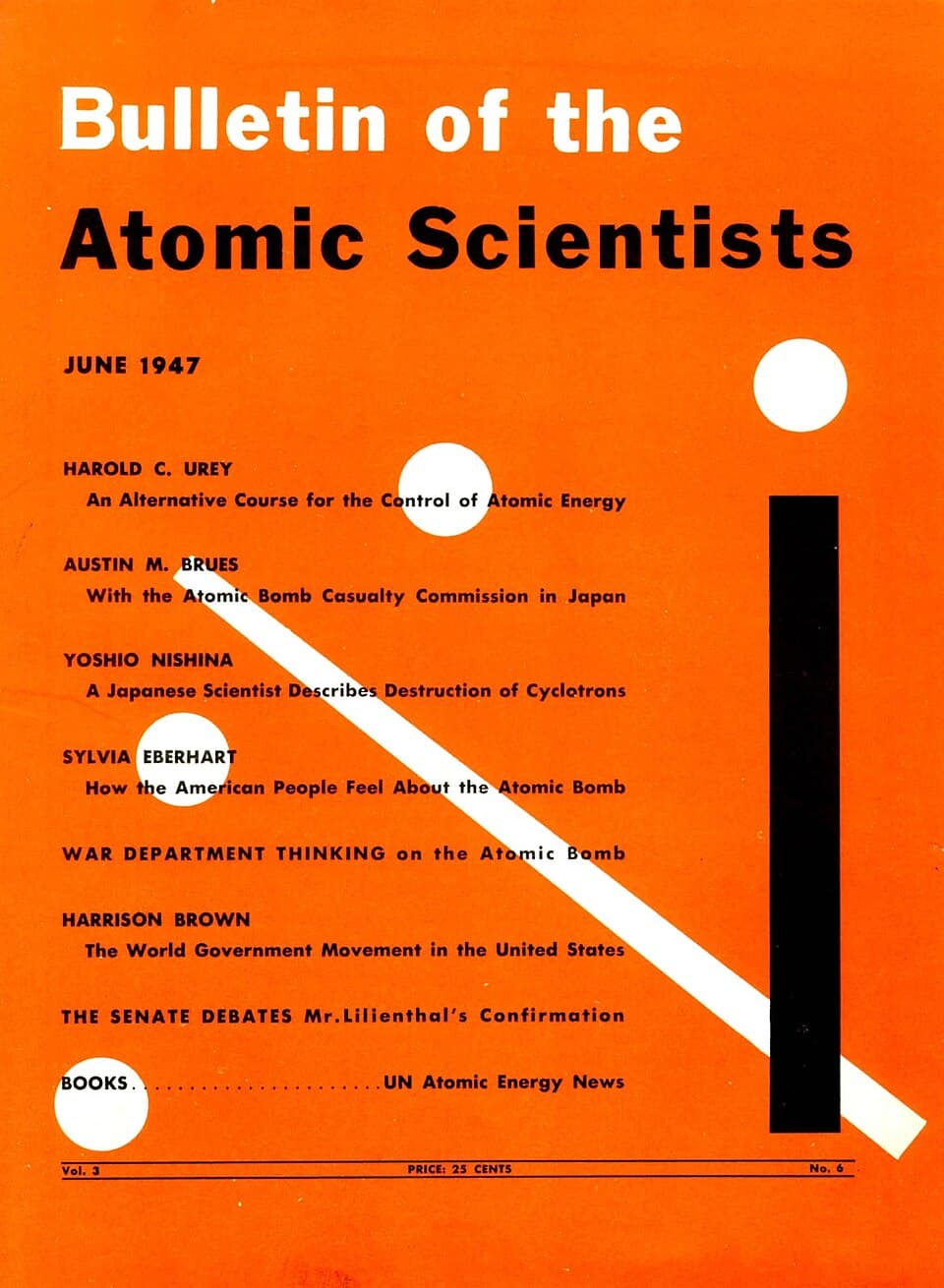
The concept was created by artist Martyl Langsdorf, whose husband Alexander Langsdorf was a Manhattan Project physicist. It first appeared on the cover of the Bulletin's magazine in June 1947, set at 7 minutes to midnight. The choice of a clock face was intentional: the scientists wanted an image that conveyed urgency without requiring technical explanation.
Who sets the clock?
The Bulletin's Science and Security Board — composed of physicists, arms control experts, climate scientists, and biosecurity specialists — meets twice a year to assess global threats. Their recommendation goes to a Board of Sponsors that includes more than a dozen Nobel Prize laureates. The final setting is announced each January.
The clock does not measure the likelihood of nuclear war in any technical or probabilistic sense. It is a communication device — a deliberate simplification designed to convey expert consensus about existential risk to a general audience. That said, its track record of rising and falling in response to genuine policy developments makes it a useful historical index of nuclear danger.
Since 2007, the Bulletin has explicitly incorporated climate change as a co-equal factor alongside nuclear weapons. Since 2017, disruptive technologies — AI, cyber weapons, biosecurity — have also been considered.
Complete Doomsday Clock Timeline (1947–2025)
| Year | Setting | Change | Key Reason |
|---|---|---|---|
| 1947 | 7 min | — | Initial setting; US has atomic monopoly but Soviet program underway |
| 1949 | 3 min | −4 min | USSR tests first atomic bomb (Joe-1), ending US nuclear monopoly |
| 1953 | 2 min | −1 min | US and USSR both test hydrogen bombs within months of each other |
| 1960 | 7 min | +5 min | Pugwash movement; scientists on both sides begin communicating |
| 1963 | 12 min | +5 min | Partial Nuclear Test Ban Treaty bans atmospheric testing |
| 1968 | 7 min | −5 min | France and China develop nukes; NPT negotiations stall; Vietnam War |
| 1969 | 10 min | +3 min | US Senate ratifies Nuclear Non-Proliferation Treaty |
| 1972 | 12 min | +2 min | SALT I and Anti-Ballistic Missile Treaty signed by Nixon and Brezhnev |
| 1974 | 9 min | −3 min | India tests first nuclear device; SALT II stalls; Watergate chaos |
| 1980 | 7 min | −2 min | SALT II fails Senate ratification; Soviet invasion of Afghanistan |
| 1981 | 4 min | −3 min | Reagan arms build-up begins; US-Soviet relations deteriorate sharply |
| 1984 | 3 min | −1 min | Both sides walk out of arms control talks; new missiles deployed in Europe |
| 1988 | 6 min | +3 min | INF Treaty signed; Reagan and Gorbachev eliminate intermediate-range missiles |
| 1990 | 10 min | +4 min | Berlin Wall falls; Cold War visibly ending |
| 1991 | 17 min | +7 min | START I signed; Soviet Union dissolves — furthest from midnight ever |
| 1995 | 14 min | −3 min | Post-Cold War arsenals remain massive; nuclear materials poorly secured |
| 1998 | 9 min | −5 min | India and Pakistan both test nuclear weapons in May 1998 |
| 2002 | 7 min | −2 min | Post-9/11; US withdraws from ABM Treaty; fear of nuclear terrorism |
| 2007 | 5 min | −2 min | North Korea tests first nuclear device; climate change added as a factor |
| 2010 | 6 min | +1 min | Obama's Prague Agenda; New START negotiations; positive signals |
| 2012 | 5 min | −1 min | Lack of follow-through on disarmament; Iran and North Korea programs |
| 2015 | 3 min | −2 min | Climate inaction; Russia-Ukraine tensions; nuclear modernization programs |
| 2017 | 2 min 30 sec | −30 sec | Trump elected; North Korea advances; Iran deal under threat |
| 2018 | 2 min | −30 sec | North Korea hydrogen bomb test; Iran deal collapse; arms control erosion |
| 2020 | 100 sec | −20 sec | INF Treaty dead; New START expiring; AI and cyber threats added |
| 2023 | 90 sec | −10 sec | Russia invades Ukraine with nuclear threats; closest ever at the time |
| 2024 | 90 sec | — | Maintained; Russia-Ukraine war ongoing; Gaza conflict; AI risks |
| 2025 | 89 sec | −1 sec | Iran nuclear acceleration; North Korea-Russia military cooperation; AI |
Era 1: The Atomic Age Begins (1947–1953)
The Doomsday Clock was born in the shadow of Hiroshima and Nagasaki. The scientists who built the bombs at Los Alamos had witnessed what they created. Many were appalled. The Bulletin of the Atomic Scientists was founded in December 1945 — two months after Japan's surrender — specifically to warn the public about nuclear dangers.
When the clock was first set to 7 minutes in 1947, the United States held a monopoly on nuclear weapons. The Soviet program was underway but its progress was unknown to Western intelligence. Seven minutes felt close — but not existentially immediate.
That changed in August 1949, when the Soviet Union detonated Joe-1, its first atomic bomb, at the Semipalatinsk Test Site in Kazakhstan. The US nuclear monopoly was over. The clock moved to 3 minutes — the first major crisis-level setting in its history.
Then came the hydrogen bomb. In November 1952, the United States tested Ivy Mike, the first thermonuclear device, with a yield of 10.4 megatons — roughly 700 times the bomb dropped on Hiroshima. Less than a year later, in August 1953, the Soviet Union tested Joe-4, its own hydrogen weapon. The Bulletin moved the clock to 2 minutes — a position that would not be seen again until 2018.
How close was 2 minutes in 1953?
In practical terms, 2 minutes in 1953 reflected the fact that both superpowers now possessed weapons capable of killing millions in a single detonation, and neither had the intercontinental delivery systems, early warning networks, or command-and-control protocols to reduce the risk of miscalculation. The deterrence doctrine of Mutually Assured Destruction (MAD) had not yet been fully articulated.
Era 2: Détente and the Test Ban (1960–1972)
The late 1950s brought the Cuban Missile Crisis, Berlin crises, and escalating arms competition — but also the first serious diplomatic efforts to manage nuclear risk. The Pugwash Conferences on Science and World Affairs, begun in 1957, brought together Western and Soviet scientists for the first time to discuss arms control outside official channels. In 1960, the clock moved back to 7 minutes.
The Cuban Missile Crisis of October 1962 did not move the clock closer to midnight — but it accelerated the diplomacy that followed. Kennedy and Khrushchev had come close enough to catastrophe that both sides were shaken into action. The Partial Nuclear Test Ban Treaty of 1963, which banned atmospheric, underwater, and outer-space nuclear testing, prompted the clock's most optimistic move yet: to 12 minutes.
The signing of the Nuclear Non-Proliferation Treaty in 1968 and its subsequent ratification moved the clock to 10 minutes in 1969. The SALT I strategic arms limitation agreement and Anti-Ballistic Missile (ABM) Treaty in 1972 pushed it to 12 minutes again — the same as 1963, and the most hopeful reading of the nuclear era.
Era 3: The Danger Returns (1974–1984)
Hope proved fragile. India's 1974 nuclear test — carried out using plutonium from a reactor built ostensibly for peaceful purposes — demonstrated that the NPT's non-proliferation architecture had gaps. SALT II, negotiated through the mid-1970s, was signed by Carter and Brezhnev in 1979 but never ratified by the US Senate after the Soviet invasion of Afghanistan. The clock moved back to 7 minutes in 1980.
The early Reagan years marked the most dangerous period since the hydrogen bomb era. Reagan's administration dramatically increased defense spending, deployed Pershing II missiles in Europe capable of striking Moscow in 6 minutes, and used rhetoric that alarmed both Soviet leaders and Western publics. The Soviets, uncertain whether a US first strike was being prepared, placed their forces on heightened alert during NATO's Able Archer 83 exercise — a scenario that came dangerously close to triggering a pre-emptive launch.
In 1981, the clock moved to 4 minutes. By 1984, it stood at 3 minutes — reflecting "the most dangerous state of affairs since the early years of the atomic age," according to the Bulletin.
The superpowers seem to be drifting, like the blind, toward catastrophe: World War III is not inevitable, but is becoming more likely as a political accident, a miscalculation, or a system failure.
— Bulletin of the Atomic Scientists, 1984 Doomsday Clock Statement
Era 4: The End of the Cold War (1988–1991)
Mikhail Gorbachev changed everything. His willingness to accept intrusive verification, dismantle intermediate-range missiles, and ultimately allow Eastern European states to leave the Warsaw Pact without Soviet military intervention produced the most rapid improvement in nuclear risk in the clock's history.
The INF Treaty of 1987, which eliminated an entire class of nuclear weapons from Europe, moved the clock to 6 minutes in 1988. The fall of the Berlin Wall in 1989 pushed it to 10 minutes in 1990.
Then, in 1991, the Soviet Union dissolved. The START I Treaty — the first agreement to actually reduce strategic nuclear arsenals — was signed by Bush and Gorbachev in July 1991, five months before the USSR ceased to exist. The clock moved to 17 minutes — the furthest from midnight in the clock's entire history, and the only reading that has ever exceeded 15 minutes.
Era 5: Proliferation and Post-Cold War Drift (1995–2006)
The 1990s brought a paradox: the Cold War was over, but the nuclear dangers didn't disappear — they changed shape. Thousands of Soviet warheads were scattered across newly independent states. Weapons-grade fissile material was poorly secured. Scientists from the former Soviet nuclear complex were available for hire. The clock moved back to 14 minutes in 1995, reflecting anxiety about this new proliferation landscape.
The simultaneous nuclear tests by India and Pakistan in May 1998 — both countries testing multiple devices within days of each other — shocked the international community. Two previously non-nuclear states had simultaneously joined the club. The clock moved to 9 minutes.
The 2001 terrorist attacks renewed fears that non-state actors might acquire nuclear material. The George W. Bush administration's 2002 withdrawal from the Anti-Ballistic Missile Treaty — which it called a Cold War relic — eliminated one of the key pillars of nuclear stability. The clock moved to 7 minutes in 2002.
Era 6: Multiple Threats, Accelerating Risk (2007–2019)
The 2007 Doomsday Clock statement marked a turning point. For the first time, the Bulletin explicitly incorporated climate change as an existential threat co-equal with nuclear weapons. North Korea's first nuclear test in 2006 added a new proliferation dimension. The clock moved to 5 minutes.
A brief period of optimism followed. President Obama's April 2009 Prague speech — pledging to seek a world without nuclear weapons — and the subsequent New START Treaty negotiations moved the clock to 6 minutes in 2010. It was the last time the clock would move away from midnight.
In 2015, amid the Ukraine crisis, the clock moved to 3 minutes for the first time since 1984. The Bulletin cited nuclear modernization programs by Russia and the United States, continuing climate inaction, and "a growing lack of trust between nuclear weapons states."
The 2017 statement introduced a new element: the clock moved to 2 minutes 30 seconds — for the first time measuring risk in fractions of minutes — citing concerns about Donald Trump's statements on nuclear weapons, the North Korean hydrogen bomb program, and the deteriorating global security environment.
Era 7: The Seconds Era (2020–2025)
In January 2020, the Bulletin took an unprecedented step: it moved the clock to 100 seconds to midnight — the first time in the clock's history that the setting had been expressed in seconds rather than minutes. The move was deliberate. The Bulletin wanted to signal that the situation had crossed a qualitative threshold.
The reasons cited included the collapse of the INF Treaty (US withdrawal in 2019), stalled New START renewal negotiations, the emergence of artificial intelligence as a factor in nuclear command-and-control, and accelerating climate change.
In January 2023, following Russia's invasion of Ukraine and Vladimir Putin's explicit nuclear threats, the clock moved to 90 seconds — breaking the record set in 1953. The Bulletin's statement was stark: "We are living in a time of unprecedented danger, and the Doomsday Clock time reflects that reality."
The clock remained at 90 seconds in 2024. In January 2025 — before the current Iran crisis began — the Bulletin moved it to 89 seconds, citing the acceleration of Iran's nuclear program, expanding North Korea-Russia military cooperation, and the increasing integration of AI systems into nuclear command structures.
The NukeClock live indicator
NukeClock's live indicator tracks real-time developments against the official Bulletin baseline. During the current Iran crisis, NukeClock's estimate has moved significantly closer than the official 89-second setting — reflecting active US-Iran military exchanges, the elimination of Iran's supreme leadership, and the potential for nuclear threshold crossing. The official Bulletin clock is updated annually; NukeClock updates continuously.
What Actually Moves the Clock?
The Bulletin evaluates threats across several dimensions when setting the clock each January:
Nuclear weapons factors:
- Size and readiness of nuclear arsenals
- Status of arms control treaties
- Doctrine changes (launch-on-warning policies, low-yield weapon development)
- Proliferation risk (new nuclear states, nuclear terrorism)
- Near-miss incidents and command-and-control reliability
Climate factors (since 2007):
- Global temperature trajectory
- Progress on emissions reductions
- Climate-conflict linkages
Disruptive technology factors (since 2017):
- AI integration into nuclear command systems
- Cyber vulnerabilities in nuclear infrastructure
- Biosecurity threats
The Bulletin has been explicit that the clock is not a prediction. It does not claim to know that nuclear war will occur within 89 seconds. It is a communication tool designed to convey the expert consensus that the margin for error has narrowed dramatically.
How Accurate Has the Clock Been?
Critics argue the Doomsday Clock is too subjective, too political, and too prone to alarm. Supporters argue it has tracked genuine policy developments with reasonable accuracy.
The historical record offers some support for both views. The clock correctly identified the early 1980s as extraordinarily dangerous — a period now confirmed by declassified documents showing the US and USSR came closer to accidental nuclear war than previously acknowledged. It correctly identified the early 1990s as a genuine period of reduced risk. It correctly anticipated the deterioration of the 2000s and 2010s.
However, the clock has also been criticized for:
- Ratchet asymmetry: It has generally been easier to move toward midnight than away from it
- Political framing: Some settings have coincided with US domestic political changes in ways that suggest ideological influence
- Conflation of threats: Combining nuclear, climate, and technology threats in a single metric may obscure more than it reveals
Despite these limitations, no other single index of nuclear risk has the longevity, institutional credibility, or public recognition of the Doomsday Clock. Its 78-year history makes it the most comprehensive longitudinal record of expert judgment about existential risk in existence.