Hiroshima and Nagasaki: What Happened When the Bombs Fell
On August 6 and 9, 1945, U.S. atomic bombs devastated Hiroshima and Nagasaki. Here is what happened, who died, and what radiation did after.
Staff Reporting and Analysis. Produces source-backed reporting, explainers, and reference pages on nuclear risk, proliferation, and escalation dynamics.
Key Sources
Start with the strongest supporting documents and reporting behind this page.
Country Profiles Mentioned
Open the profile pages for the countries referenced directly in this article.
Related Rivalries
These comparison pages help place this article inside the broader balance of power and rivalry structure.
Rivalry
Is This Like the Cuban Missile Crisis? Comparing 1962 and 2026
A 1962 vs 2026 comparison of decision windows, nuclear proximity, escalation control, and why the Iran crisis is framed as a modern Cuban Missile moment.
2026-03-03
Rivalry
Russia vs US Nuclear Forces: 2026 Strategic Comparison
Russia and US nuclear forces compared by warheads, delivery systems, modernization, spending, and doctrine across the world's two largest arsenals.
2026-03-03
Rivalry
India vs Pakistan Nuclear Weapons: A Complete 2026 Comparison
India vs Pakistan nuclear comparison: warheads, delivery systems, doctrines, defense spending, and how Kashmir escalation could strain deterrence.
2026-03-03
Related Doctrines
These explainers provide the strategic concepts behind the escalation, deterrence, and risk logic discussed here.
Doctrine
How Many Nukes Would It Take to Destroy the World?
How many weapons could trigger civilization-scale collapse? We break down nuclear-winter science, blast and fallout effects, and risk from limited exchanges.
2026-03-03
Doctrine
What Is Nuclear Fallout? Radiation Effects and Survival Basics
What is nuclear fallout? Learn how it forms, key radiation types, health effects, the 7-10 rule timeline, and practical shelter and protection steps.
2026-03-03
Doctrine
How Nuclear Bombs Work: Fission, Fusion, and Weapon Physics
Nuclear weapons release energy through fission or fusion. Learn gun-type and implosion designs, hydrogen bombs, yield, and the Teller-Ulam model.
2026-03-03
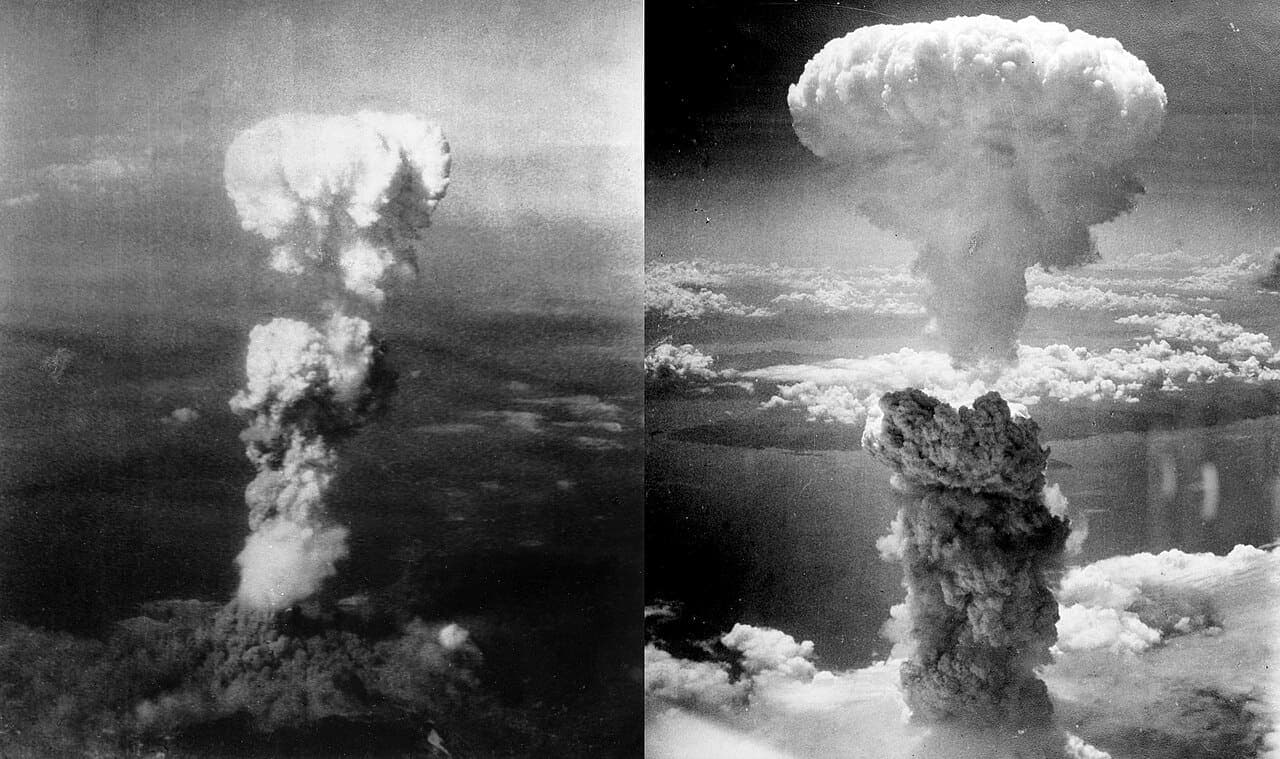
On August 6, 1945, at 8:15 in the morning, a single bomb erased a city. Three days later, a second bomb fell on Nagasaki. Between 129,000 and 226,000 people died — most of them civilians — in the only use of nuclear weapons in the history of warfare. Here is what happened, and why it still matters.
August 6, 1945: Hiroshima
At 2:45 AM, the B-29 Superfortress Enola Gay lifted off from North Field on Tinian Island in the Mariana Islands. Its crew of twelve, commanded by Colonel Paul Tibbets, climbed to 31,000 feet. In the bomb bay hung a 10-foot, 9,700-pound weapon called Little Boy.
Little Boy was a gun-type fission bomb. Its mechanism was brutally simple: a conventional explosive fired one sub-critical mass of uranium-235 down a gun barrel into a second, creating a supercritical assembly. The reaction was nearly instantaneous.
Hiroshima, a city of approximately 350,000 people and a major Japanese Army headquarters, had been deliberately preserved from conventional bombing raids to allow accurate assessment of the new weapon's effects.
At 8:15 AM and 17 seconds, the bomb detonated at an altitude of 1,968 feet (600 meters) above the Shima Surgical Clinic, approximately 800 feet from the intended aim point.
What Happened in the First Second
The fireball formed. In less than one second, it expanded to 900 feet in diameter. Temperatures at the hypocenter — the point on the ground directly below the detonation — reached an estimated 3,000–4,000°C.
Within a radius of approximately 500 meters, everything was vaporized. Buildings, vehicles, trees, and people were simply gone.
The Shima Surgical Clinic was never found. The shadows of people caught in the open at the moment of detonation were permanently burned into stone surfaces — the intense thermal flash bleached the surrounding rock while the person's body blocked the radiation, leaving dark silhouettes on bridge railings, steps, and walls.
The Blast Wave
Approximately half a second after detonation, the shock wave hit. Moving at roughly the speed of sound, it demolished everything in its path. Within 1.6 km of the hypocenter, virtually every building was destroyed. Within 3.2 km, most buildings suffered major structural damage.
The overpressure at various distances:
| Distance from hypocenter | Peak overpressure | Effect |
|---|---|---|
| 0.5 km | >100 psi | Complete destruction, total casualties |
| 1.0 km | ~30 psi | Reinforced concrete buildings destroyed |
| 2.0 km | ~10 psi | Unreinforced masonry buildings destroyed |
| 3.0 km | ~5 psi | Serious damage to all structures |
| 5.0 km | ~2 psi | Moderate damage, windows broken |
The blast wave was followed immediately by a powerful reverse suction — the air rushing back toward the explosion center as the fireball expanded and then cooled. This created a wind storm that fanned fires across the destroyed city.
The Firestorm
Within 20 minutes of the detonation, hundreds of fires throughout the city had merged into a single firestorm. A firestorm is self-sustaining — it creates its own inward-rushing wind system that feeds oxygen to the fire's center. Hiroshima burned for approximately six hours.
The firestorm extended roughly 2 km in all directions from the hypocenter and effectively destroyed everything wooden — which was most of the city's residential and commercial buildings.
The Dead
The immediate death toll at Hiroshima is estimated between 90,000 and 166,000. The range reflects the difficulty of counting in a city where tens of thousands of people were vaporized, incinerated, or trapped in collapsed buildings and died in the fires.
By the end of 1945, radiation effects had killed additional thousands. The total death toll by December 31, 1945 is estimated at 90,000–166,000; some Japanese estimates place the final figure higher.
The Three Days Between
After Hiroshima, the Japanese government did not immediately surrender. The Army's Supreme War Council debated the situation. Some military leaders argued that a single bomb, however devastating, was insufficient evidence of what the US could actually deliver — and that surrender remained unthinkable.
The United States had two bombs ready.
President Truman, who had authorized the bombing campaign in a directive issued July 25, had issued an ultimatum at the Potsdam Conference calling for Japan's unconditional surrender or "prompt and utter destruction." No surrender came.
On August 8, the Soviet Union declared war on Japan and began its invasion of Manchuria — a development some historians argue was as decisive as the atomic bombs in Japan's decision to surrender.
On August 9, the second bomb fell.
August 9, 1945: Nagasaki
The original target for the second bomb was Kokura, a major arms manufacturing center. The B-29 Bockscar, commanded by Major Charles Sweeney, arrived over Kokura at 9:44 AM to find it covered by smoke and clouds from a conventional firestorm raid on neighboring Yahata the previous day.
After three passes that failed to acquire the target visually, fuel running low, and with a three-hour window before a weather front would close the skies entirely, Sweeney turned south toward the secondary target: Nagasaki.
Nagasaki was a port city of approximately 250,000 people. The terrain — hills surrounding a narrow valley — would contain and focus the blast in ways that Hiroshima's flat geography had not.
Fat Man, the plutonium implosion bomb, detonated at 11:02 AM at 1,650 feet altitude. It yielded approximately 21 kilotons — 40% more energy than Little Boy.
Why Nagasaki's Toll Was Lower Than Hiroshima's
Nagasaki's death toll — 39,000–80,000 by year's end — was lower than Hiroshima's despite Fat Man's higher yield for two reasons:
Geography: Nagasaki's hills contained the blast. Unlike Hiroshima's flat delta topography, the surrounding ridges cut off the blast wave and thermal radiation from much of the city's residential population.
Miss distance: The bomb detonated approximately 1.9 miles from the original aim point, over the Urakami Valley industrial district rather than the city center.
Radiation: The Bomb That Kept Killing
For survivors — known in Japanese as hibakusha ("explosion-affected people") — the bombing was not over when the fires died.
Acute radiation syndrome killed thousands who had survived the initial blast and thermal effects. The syndrome progresses through four stages: early nausea and vomiting, an apparent recovery period, then a collapse of the immune system as bone marrow stops producing blood cells, followed by death from infection and bleeding in untreated cases.
Without any functioning hospital system in either city, acute radiation syndrome was nearly universally fatal in those who received doses above 300–400 rem.
Long-Term Radiation Effects
The Atomic Bomb Casualty Commission — later reorganized as the Radiation Effects Research Foundation — has tracked the health outcomes of Hiroshima and Nagasaki survivors for over 70 years. Its findings represent the most comprehensive database of human radiation exposure ever compiled:
Leukemia: Rates elevated among survivors, peaking in 1950–1952 and declining thereafter but remaining elevated for decades. The risk was highest among those who were closest to the hypocenter.
Solid cancers: Elevated rates of thyroid, breast, lung, stomach, and other cancers, persisting across the survivor population for the remainder of their lives.
Fetal effects: Women pregnant at the time of the bombings showed elevated rates of miscarriage, infant mortality, and developmental abnormalities in children who survived, particularly those exposed during the first trimester.
Psychological effects: Survivors faced social stigma — fear of radiation contagion, discrimination in marriage and employment, and in many cases the total destruction of their family and social networks.
What hibakusha means today
As of 2020, approximately 136,000 registered hibakusha were still alive in Japan, with an average age of over 83. The Japanese government provides them with medical care, annual health checks, and financial allowances. Their testimony has been central to Japan's official policy of non-nuclear armament and its role as a voice for disarmament in international forums.
The Decision to Drop the Bombs
The decision to use atomic weapons against Japan remains one of the most debated acts in military history. The arguments made in 1945 and subsequently:
The case made at the time: US military planners projected that an invasion of the Japanese home islands (Operation Downfall) would cost between 250,000 and 1 million American casualties and up to 10 million Japanese. The atomic bomb, the argument went, would end the war faster and save more lives overall.
The counterarguments: Japan was already close to surrender; the Soviet declaration of war on August 8 would have accomplished the same outcome. The targeting of civilian population centers violated the laws of war. Demonstrating the weapon on an uninhabited area or a military target would have achieved the political objective without mass civilian deaths.
The historical consensus (such as it is): Historians remain divided. The "would have surrendered anyway" argument is supported by significant evidence from Japanese government records but disputed by scholars who emphasize the Japanese military's determination to continue fighting. The question of what would have happened without the bombs cannot be answered with certainty.
What is certain is that the bombings established a precedent — the demonstrated willingness to use nuclear weapons against civilian populations — that has shaped deterrence doctrine, arms control negotiations, and the psychology of nuclear risk ever since.
Now I am become Death, the destroyer of worlds.
— J. Robert Oppenheimer, recalling the Bhagavad Gita verse that came to mind as he watched the Trinity test, July 16, 1945 — three weeks before Hiroshima
Why Hiroshima and Nagasaki Matter in 2026
Every modern estimate of nuclear weapons' effects — every casualty projection, every nuclear winter model, every city-level impact calculator — is calibrated against Hiroshima and Nagasaki. They are the only empirical data we have.
When the Bulletin of the Atomic Scientists places the Doomsday Clock at 89 seconds, when modelers project the consequences of a nuclear exchange between India and Pakistan, when planners calculate the effects of a tactical nuclear weapon in Europe — all of those calculations trace back to two Japanese cities in August 1945.
The bombs used in 1945 were primitive by the standards of any modern nuclear arsenal. Little Boy yielded 15 kilotons. A modern Russian SS-18 reentry vehicle yields 500–750 kilotons — 33 to 50 times more powerful. A US W88 warhead, carried on Trident submarine-launched missiles, yields approximately 475 kilotons. A single modern submarine carries enough warheads to destroy every major city in a country the size of France.
The scale of what happened in Hiroshima and Nagasaki — translated to the yields and quantities of weapons that exist today — is the arithmetic of what nuclear deterrence is supposed to prevent.
Scale comparison
The Hiroshima bomb (15 kt) would rank as one of the smallest devices in any modern nuclear arsenal. Russia's largest warheads are approximately 50 times more powerful. The combined destructive yield of today's global nuclear arsenal is roughly 6,600 times greater than all of the conventional explosives used in World War II combined.
August 15: Japan's Surrender
On August 15, 1945 — six days after Nagasaki — Emperor Hirohito broadcast Japan's surrender in a recorded radio address. It was the first time most Japanese citizens had heard his voice. The formal surrender was signed aboard the USS Missouri on September 2, 1945, ending the Second World War.
The nuclear age had begun. In the 80 years since, nuclear weapons have never been used in warfare again — a fact that is either a tribute to deterrence, a product of luck, or some combination of the two that no one can confidently disentangle.
Understanding Hiroshima and Nagasaki is not an act of historical nostalgia. It is the necessary baseline for grasping what is at stake every time a nuclear-armed state makes a decision about war and peace.