Tsar Bomba: The Biggest Nuclear Weapon Ever Tested
Tsar Bomba, tested by the Soviet Union on October 30, 1961, yielded about 57 megatons, becoming the most powerful man-made explosion ever recorded.
Staff Reporting and Analysis. Produces source-backed reporting, explainers, and reference pages on nuclear risk, proliferation, and escalation dynamics.
Key Sources
Start with the strongest supporting documents and reporting behind this page.
Country Profiles Mentioned
Open the profile pages for the countries referenced directly in this article.
Related Rivalries
These comparison pages help place this article inside the broader balance of power and rivalry structure.
Rivalry
US Military vs Iran Military: A Complete 2026 Comparison
US vs Iran military comparison across personnel, air and naval power, missiles, budgets, and how asymmetry shapes escalation outcomes in 2026.
2026-03-03
Rivalry
Iran Crisis 2026 vs 2019 Tensions: What's Different This Time
How the 2026 Iran crisis differs from 2019: leadership decapitation, larger retaliation, Hormuz closure risk, and a sharper nuclear escalation path.
2026-03-03
Rivalry
Is This Like the Cuban Missile Crisis? Comparing 1962 and 2026
A 1962 vs 2026 comparison of decision windows, nuclear proximity, escalation control, and why the Iran crisis is framed as a modern Cuban Missile moment.
2026-03-03
Related Doctrines
These explainers provide the strategic concepts behind the escalation, deterrence, and risk logic discussed here.
Doctrine
How Nuclear Bombs Work: Fission, Fusion, and Weapon Physics
Nuclear weapons release energy through fission or fusion. Learn gun-type and implosion designs, hydrogen bombs, yield, and the Teller-Ulam model.
2026-03-03
Doctrine
What Is Nuclear Fallout? Radiation Effects and Survival Basics
What is nuclear fallout? Learn how it forms, key radiation types, health effects, the 7-10 rule timeline, and practical shelter and protection steps.
2026-03-03
Doctrine
Nuclear Fallout Map: How to Read One
Nuclear fallout map guidance: read wind plumes, timing, and shelter zones without false certainty. Learn the signals that matter.
2026-05-13
On October 30, 1961, a Soviet Tu-95 bomber released a weapon so large that its own crew had only a 50% chance of surviving the shockwave they were about to create. The Tsar Bomba — RDS-220, the King of Bombs — detonated at 8,900 feet altitude over the Soviet Arctic and released more energy than all the conventional explosives used in all of World War II, combined. This is its story.
The Context: Why Stalin's Heirs Wanted the Biggest Bomb
By 1961, the nuclear arms race had been running for twelve years. The United States had tested the first hydrogen bomb (Ivy Mike, 10.4 megatons) in 1952. The Soviet Union had replied with its own thermonuclear test (RDS-37, 1.6 megatons) in 1955. Each side had been steadily escalating yields ever since.
Soviet Premier Nikita Khrushchev needed a demonstration.
The geopolitical pressure in 1961 was acute. The United States had established a significant lead in deliverable nuclear warheads. The failed Bay of Pigs invasion of Cuba in April had embarrassed the Kennedy administration but had not materially changed the strategic balance. Soviet attempts to force Western powers out of Berlin had generated a crisis that had divided the city with a wall — but not resolved the underlying confrontation.
In this environment, Khrushchev saw value in a single act of overwhelming military theater: a nuclear test so enormous that it could not be ignored. He had told his weapons scientists in July 1961 that he wanted a bomb of 100 megatons.
They delivered one that was close enough.
The Bomb: Three Stages, One Detonation
The RDS-220 was a three-stage thermonuclear weapon — a design that went beyond the standard two-stage Teller-Ulam configuration used in most thermonuclear devices.
A standard two-stage thermonuclear weapon uses:
- A fission primary to compress and ignite
- A fusion secondary
The RDS-220 added a third stage: the fusion energy from the secondary was used to ignite yet another fission-fusion assembly, further multiplying the yield.
The original design used a uranium-238 tamper around the fusion secondary. Neutrons from the fusion reaction would cause fast fission in the U-238, dramatically boosting total yield — this is what gave the design its theoretical 100-megaton potential.
The problem was radioactive fallout.
Sakharov's modification
Andrei Sakharov — the physicist who led the RDS-220 design effort and who would later become the Soviet Union's most prominent dissident and a Nobel Peace Prize laureate — made a decisive intervention.
A 100-megaton weapon with a U-238 tamper would produce so much radioactive fallout that the radiation hazard during delivery would be extreme. More importantly, the shock wave from 100 megatons would almost certainly destroy the Tu-95 carrying it, even at maximum altitude and with a parachute-retarded drop giving the aircraft 188 seconds to escape.
Sakharov replaced the uranium tamper with lead. This absorbed the fast neutrons from the fusion stage rather than fissioning — eliminating the third stage's contribution to yield, but also eliminating most of the fallout and, crucially, reducing the yield to approximately 50 megatons (the actual yield was closer to 57 megatons).
Even so, the delivery crew were given odds of 50% survival. They volunteered for the mission.
The survival question
The Tu-95V aircraft carrying the Tsar Bomba was stripped of all non-essential equipment and painted white to reflect thermal radiation. A parachute retardation system slowed the bomb's descent, giving the aircraft approximately 188 seconds to reach a safe distance. Theoretical blast calculations gave the crew a 50% chance of survival. The pilot, Major Andrei Durnovtsev, was later promoted to Lieutenant Colonel and awarded the Hero of the Soviet Union. His crew survived.
October 30, 1961: The Test
The test site was Sukhoy Nos on Novaya Zemlya — a remote archipelago in the Soviet Arctic approximately 1,300 kilometers from the Norwegian mainland and 1,800 kilometers from the nearest major Soviet city.
At 11:32 AM Moscow time, Major Durnovtsev released the RDS-220 from 10,500 meters altitude (34,500 feet). The bomb fell on its parachute for 188 seconds, slowing from 10,500 meters to 4,000 meters (13,100 feet) — its designed burst altitude.
At 11:33:00 AM, the bomb detonated.
What happened in the first seconds
The fireball expanded to a maximum radius of approximately 3 kilometers — large enough to reach the ground from burst altitude, making it both a ground burst and an air burst simultaneously, even though the weapon was designed as an air burst. The fireball was visible from 1,000 kilometers.
The flash was bright enough, even under cloud cover, to cause temporary blindness in observers 60–160 kilometers away.
The aircraft was 45 kilometers away when the bomb detonated. The shock wave caught it and dropped it nearly 1,000 meters in altitude before the pilots recovered control.
The measured effects
| Effect | Measurement |
|---|---|
| Yield | ~57 megatons (some Soviet estimates: 58.6 Mt) |
| Fireball radius | ~3.0 km (1.9 miles) |
| Fireball maximum altitude | ~10 km |
| Mushroom cloud height | ~67 km (42 miles) |
| Mushroom cloud cap diameter | ~95 km (59 miles) |
| Blast window breakage | Reported up to 900 km away |
| Seismic magnitude | 5.0–5.25 (equivalent earthquake) |
| Ionospheric disruption | Radio communications disrupted for ~1 hour across Northern Europe |
The shock wave circled the Earth three times before dissipating. Buildings in the town of Severny on Novaya Zemlya, some 55 kilometers from ground zero and abandoned for the test, were completely destroyed. Wooden buildings 160 kilometers away were damaged.
What Tsar Bomba Would Have Done to a City
The Tsar Bomba was never intended for operational deployment against a specific target — but modeling its effects on a populated area illustrates the scale.
Detonated at its optimal burst altitude over New York City:
- Fireball (3 km radius): Would vaporize Manhattan south of 59th Street
- Severe blast zone (12 km radius): Would completely destroy all of New York City, Brooklyn, Queens, Jersey City, and Newark
- Moderate blast zone (35 km radius): Would cause severe damage from Bridgeport, CT to Lakewood, NJ — a circle covering nearly all of northeastern New Jersey and southern Connecticut
- Thermal radiation zone (70+ km radius): Third-degree burns at distances reaching the outer suburbs of Philadelphia
Unlike a modern warhead optimized for a single city, the Tsar Bomba's radius was so large that it represented overkill for virtually any single target. No city on earth would require a 57-megaton weapon to destroy; a weapon of 1–2 megatons would accomplish the same urban destruction far more efficiently, with delivery flexibility and multiple warheads covering multiple targets.
This efficiency argument is why the Tsar Bomba was never deployed.
Why It Was Never a Real Weapon
For all its destructive power, the Tsar Bomba was practically useless as a military weapon for several reasons:
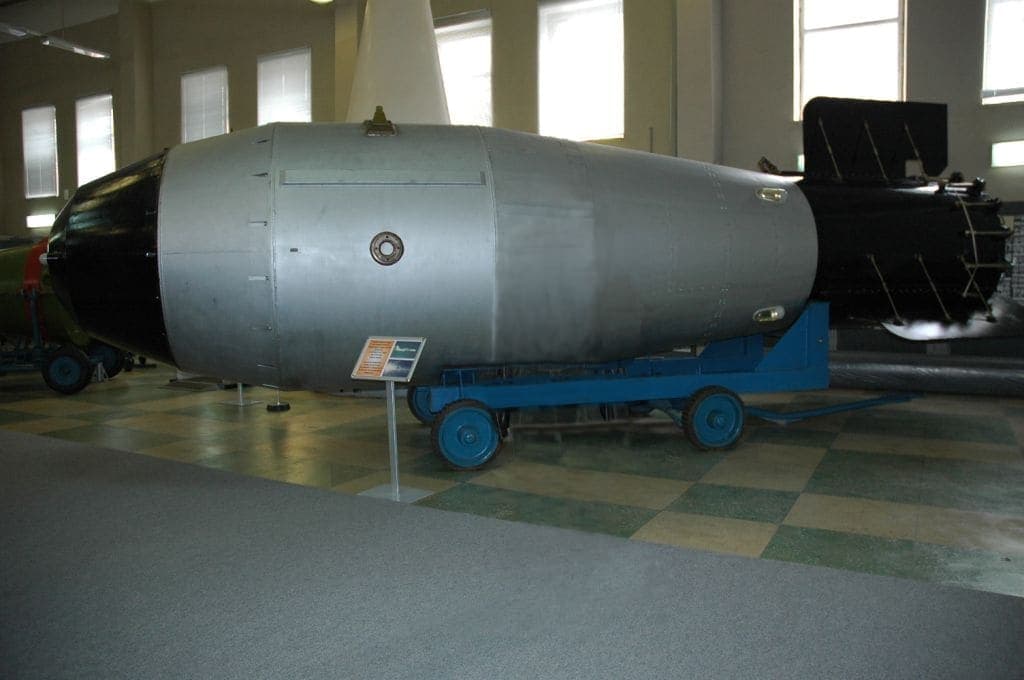
Size and weight. The bomb weighed 27 metric tons and measured 8 meters (26 feet) in length and 2 meters (6.5 feet) in diameter. It could only be carried by a specially modified Tu-95V heavy bomber — a slow, propeller-driven aircraft with an extremely large radar cross-section and no supersonic evasion capability. Against 1961 US air defenses, getting close enough to use the weapon would have been extremely difficult.
Delivery vulnerability. Even without air defense concerns, the 50% crew survival estimate reflects a fundamental problem: the weapon's effects radius overlaps with the aircraft's ability to escape. Achieving reliable delivery at yields above 25–30 megatons is inherently difficult with aircraft.
Strategic redundancy. By 1961, Soviet military planners had concluded that a thousand missiles of 1-megaton yield covering a thousand targets was far more militarily valuable than a single 50-megaton bomb covering one target very thoroughly. The logic of arms race targeting favored numbers over single extreme yields.
ICBM reentry vehicle limitations. No ICBM warhead could accommodate the RDS-220's physical dimensions. The trend in warhead development was toward miniaturization — smaller, lighter weapons with higher yields per kilogram. The Tsar Bomba pointed in exactly the wrong direction.
The efficient alternative
The same year as the Tsar Bomba test, the Soviet Union was deploying the R-7 ICBM with a 3-megaton warhead in numbers that the RDS-220 could never match. A single Soviet strike plan might call for 300–500 ICBMs targeting US strategic assets — a combined yield of 900 megatons to 1.5 gigatons, delivered reliably and simultaneously, against which US air defenses were essentially helpless. The Tsar Bomba, for all its spectacle, was militarily irrelevant by the time it exploded.
Andrei Sakharov's Transformation
The story of the Tsar Bomba cannot be told without the story of its principal designer's disillusionment.
Andrei Sakharov was the most important Soviet nuclear weapons physicist after Igor Kurchatov. He had led the RDS-37 thermonuclear test in 1955 and the RDS-220 program in 1961. He was three times a Hero of Socialist Labour.
After the Tsar Bomba test, something changed.
Sakharov had begun protesting atmospheric nuclear testing in the late 1950s, alarmed by calculations showing that radioactive fallout from atmospheric tests would cause cancer deaths in populations far from test sites. The Tsar Bomba accelerated his transformation. By 1968, he had written and circulated "Reflections on Progress, Peaceful Coexistence, and Intellectual Freedom" — a document calling for convergence between the Soviet and American systems, nuclear disarmament, and civil liberties.
He was removed from weapons work. He continued to publish and organize. In 1980, after protesting the Soviet invasion of Afghanistan, he was exiled to the city of Gorky under KGB surveillance. He was allowed to return to Moscow in 1986 by Mikhail Gorbachev.
In 1975, Andrei Sakharov was awarded the Nobel Peace Prize. He had built the biggest bomb in history and spent the next thirty years trying to prevent it from being used.
Each of us must make our own peace with the knowledge of what we have created. I made mine by understanding that the only moral response to nuclear weapons is to eliminate them.
— Andrei Sakharov, paraphrased from his 1975 Nobel Peace Prize lecture
The Cold War Context: Berlin and Cuba
The Tsar Bomba test occurred at a specific moment in Cold War history, and the timing was not accidental.
In August 1961 — two months before the test — Soviet and East German forces erected the Berlin Wall, dividing the city and triggering a confrontation with Western powers. Kennedy placed US forces on alert; the possibility of miscalculation leading to armed conflict was real.
In September 1961, the Soviet Union ended a voluntary moratorium on nuclear testing (matched by the United States) by conducting a series of tests — of which Tsar Bomba was the culmination.
One year after the Tsar Bomba test, the Cuban Missile Crisis would bring the world to the brink of nuclear war. Khrushchev and Kennedy were negotiating with the backdrop of that October 30, 1961 fireball — both knowing what the weapons they commanded could do.
Whether the Tsar Bomba made Khrushchev more or less willing to back down in Cuba is debated by historians. What is clear is that the United States had taken careful note of its yield and updated its casualty projections accordingly.
The Largest US Weapon: B41
For comparison, the largest nuclear weapon ever deployed by the United States was the B41 gravity bomb, with a maximum yield of approximately 25 megatons. It was deployed from 1961 to 1976 and then retired. Like the Tsar Bomba, it was considered too powerful to be militarily practical against any single target.
The largest US weapon currently in service is the B83-1 gravity bomb, with a maximum yield of approximately 1.2 megatons — less than one-fiftieth of the Tsar Bomba. The United States plans to retire the B83-1 in coming years.
The trend in both superpowers' arsenals since the 1970s has been consistently toward smaller yields, more warheads, higher accuracy, and more survivable delivery platforms — moving away from the Tsar Bomba logic entirely.
What Tsar Bomba Actually Demonstrated
The test proved several things simultaneously:
Technical capability: A three-stage thermonuclear weapon could achieve yields far exceeding anything previously demonstrated. The Soviet nuclear weapons program, which had been dismissed in the early 1950s as at least a decade behind the United States, was demonstrably capable of matching or exceeding any US design.
Political will: Khrushchev was willing to conduct spectacular tests regardless of international reaction. This was partly aimed at the United States and partly at the Chinese leadership, which had been publicly questioning Soviet nuclear resolve.
Strategic futility: The RDS-220 was never deployed. The test demonstrated that there was a practical ceiling on useful bomb yield — somewhere around 1–10 megatons for a warhead that could actually be delivered accurately against a point target. Above that, you are essentially bombing a county rather than a city, and the marginal strategic value approaches zero.
The human cost of testing: The 1961–62 Soviet test series, of which the Tsar Bomba was the culmination, produced so much radioactive fallout that public pressure for a test ban became overwhelming. The Limited Test Ban Treaty — prohibiting atmospheric, underwater, and space nuclear tests — was signed by the United States, Soviet Union, and United Kingdom in August 1963, less than two years after the Tsar Bomba test.
Andrei Sakharov had lobbied for that treaty for years. It was signed in the shadow of the weapon he had designed.