Manhattan Project: How Oppenheimer Built the Atomic Bomb
The Manhattan Project built the first nuclear weapons from 1942 to 1945. Follow the path from Einstein's warning letter to Trinity and Hiroshima.
Staff Reporting and Analysis. Produces source-backed reporting, explainers, and reference pages on nuclear risk, proliferation, and escalation dynamics.
Key Sources
Start with the strongest supporting documents and reporting behind this page.
Country Profiles Mentioned
Open the profile pages for the countries referenced directly in this article.
Related Rivalries
These comparison pages help place this article inside the broader balance of power and rivalry structure.
Rivalry
Iran War vs Iraq War: How the 2026 and 2003 Conflicts Compare
Iran 2026 vs Iraq 2003 compared across legal authority, coalition structure, force design, economic shock, and the central role of nuclear risk.
2026-03-03
Rivalry
Is This Like the Cuban Missile Crisis? Comparing 1962 and 2026
A 1962 vs 2026 comparison of decision windows, nuclear proximity, escalation control, and why the Iran crisis is framed as a modern Cuban Missile moment.
2026-03-03
Rivalry
US Military vs Iran Military: A Complete 2026 Comparison
US vs Iran military comparison across personnel, air and naval power, missiles, budgets, and how asymmetry shapes escalation outcomes in 2026.
2026-03-03
Related Doctrines
These explainers provide the strategic concepts behind the escalation, deterrence, and risk logic discussed here.
Doctrine
What Is Nuclear Fallout? Radiation Effects and Survival Basics
What is nuclear fallout? Learn how it forms, key radiation types, health effects, the 7-10 rule timeline, and practical shelter and protection steps.
2026-03-03
Doctrine
What Would Happen If a Nuke Hit New York City?
What if a nuclear weapon hit New York City? We model blast zones, casualties, fallout spread, infrastructure breakdown, and realistic survival windows.
2026-03-03
Doctrine
How Are Nuclear Tests Detected? Verification Guide
How are nuclear tests detected? Learn the sensors, data flow, and proof standards used to identify underground, underwater, and atmospheric blasts.
2026-04-17
In 1939, Albert Einstein signed a letter warning President Roosevelt that Germany might be building an atomic bomb. Six years later, the United States had built three. The Manhattan Project — the most ambitious scientific and industrial undertaking in human history — changed warfare, geopolitics, and the relationship between science and the state forever. This is how it happened.
The Letter That Started It All
On August 2, 1939, Albert Einstein signed a letter to President Franklin D. Roosevelt that was among the most consequential pieces of correspondence in history.
The letter, drafted primarily by physicist Leó Szilárd — a Hungarian refugee who had fled Nazi Germany — warned that recent research in nuclear fission had made it "conceivable" to produce "extremely powerful bombs of a new type." It explicitly raised the possibility that Germany was already pursuing such weapons.
Roosevelt did not immediately act. The letter sat on his desk for weeks. But in October 1939, he assembled a committee — the "Advisory Committee on Uranium" — to assess the situation.
The committee's early reports were cautious and underfunded. The program moved slowly. What changed everything was a classified British report in 1941.
The MAUD Report
In July 1941, British scientists working under the code name "MAUD" concluded that a uranium bomb of explosive power equivalent to 1,800 tons of TNT could be built using only 25 pounds of uranium-235. They estimated it could be ready within two years — before any anticipated end to the war — and recommended an immediate, full-scale development program.
American scientists had been skeptical. The MAUD report — combined with the entry of the United States into World War II following Pearl Harbor on December 7, 1941 — resolved that skepticism.
In June 1942, President Roosevelt authorized the Manhattan Engineer District. General Leslie Groves, who had just finished overseeing construction of the Pentagon, was appointed its military director. He had six weeks.
The Organization of an Impossible Project
Groves immediately understood the fundamental challenge: the science was incomplete, the industrial processes untested, and the military deadline absolute. He decided to build everything in parallel, accepting enormous redundancy and cost to compress timelines.
The project would operate on three simultaneous tracks:
- Uranium enrichment — separating the fissile U-235 isotope from natural uranium (where it comprises only 0.7%)
- Plutonium production — creating plutonium-239, a fissile material that doesn't exist in nature, in nuclear reactors
- Weapon design — determining how to trigger a nuclear explosion reliably
Each track required industrial infrastructure that did not yet exist.
Los Alamos: The Secret City
Groves needed a remote, defensible location for the weapons laboratory where scientists could work in secrecy and military security could be maintained. In November 1942, he chose a mesa in the mountains of northern New Mexico: Los Alamos, then the site of a small boys' school.
To direct this laboratory, Groves chose J. Robert Oppenheimer — a theoretical physicist from Berkeley who had never administered a large organization, had no Nobel Prize, and had a complicated left-wing political background that would haunt him a decade later.
Groves's reasoning: Oppenheimer was, in Groves's words, "a genius." He had a rare ability to communicate across disciplines, inspire difficult people, and hold in his mind simultaneously the theoretical physics, engineering, and military requirements of the problem. No one else could do what needed to be done.
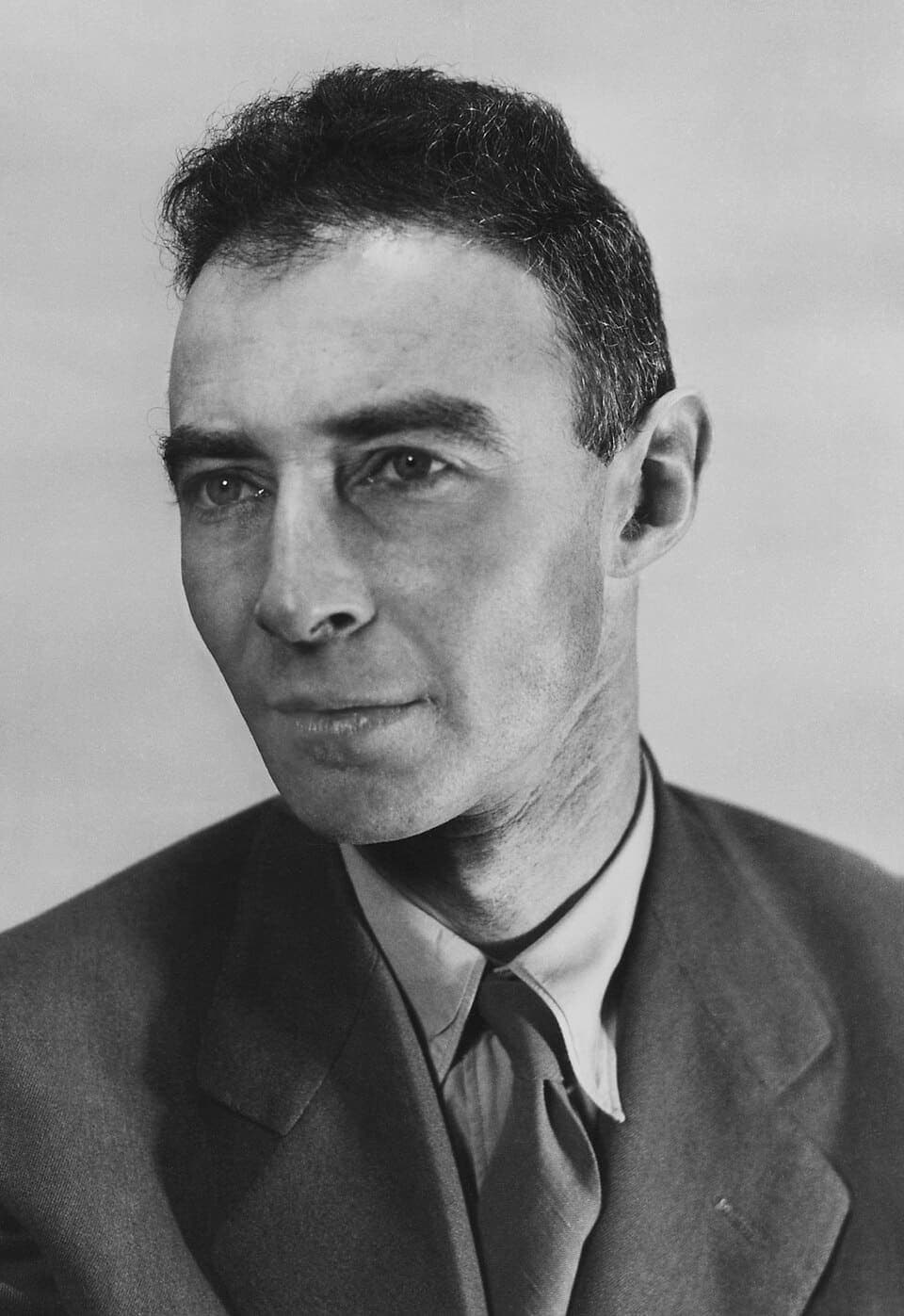
Oppenheimer recruited the most extraordinary assembly of scientific talent ever gathered: Enrico Fermi, Hans Bethe, Niels Bohr (operating under the alias Nicholas Baker), Edward Teller, Victor Weisskopf, Klaus Fuchs, Richard Feynman, and dozens of others. Many were European refugees who had fled Hitler. They lived in a classified town with no official name, receiving mail addressed only to "P.O. Box 1663, Santa Fe, New Mexico."
Oak Ridge: The Uranium Factory
Enriching uranium-235 to weapons-grade concentration required separating an isotope that differs from its natural counterpart by less than 1% in atomic mass. This was an industrial-scale chemical problem of extraordinary difficulty.
At Oak Ridge, Tennessee, Groves built the largest building in the world — a gaseous diffusion plant stretching half a mile long. The K-25 plant alone required more electrical power than the city of Boston. The workers who operated it didn't know they were enriching uranium; they simply monitored dials and valves on machinery they weren't permitted to understand.
Oak Ridge at its peak employed 75,000 people and consumed one-seventh of the entire US electricity supply.
Hanford: The Plutonium Works
Plutonium-239 is produced when uranium-238 absorbs a neutron in a nuclear reactor. Producing it in weapons-grade quantities required industrial-scale reactors that had never been built.
At Hanford, Washington — a remote area on the Columbia River selected for its abundant hydroelectric power and cooling water — Groves built the world's first plutonium production reactors. The B Reactor, completed in September 1944, was the first full-scale nuclear reactor in history.
It produced plutonium. But the implosion weapon design required a sphere of plutonium compressed by precisely shaped conventional explosive charges, firing simultaneously to within microseconds of each other. That problem would consume Los Alamos for two years.
The Science at Los Alamos
The fundamental physics was understood. The engineering was not.
A uranium gun-type bomb — firing one sub-critical mass down a barrel into another — was conceptually simple and could be assembled with relatively straightforward machining. The problem was that gun-type weapons were inefficient and required large quantities of enriched uranium, which was extremely difficult to produce. The design team estimated that enough uranium-235 for a single gun-type bomb would take until mid-1945 to accumulate.
Plutonium was far more abundant from the Hanford reactors — but plutonium presented a fatal problem for the gun-type design: reactor-produced plutonium contains trace amounts of Pu-240, which undergoes spontaneous fission at a rate high enough that a gun-type weapon would "pre-initiate" — begin the chain reaction while the sub-critical masses were still approaching each other — and produce only a low-yield "fizzle."
The only viable plutonium design was implosion: surrounding a subcritical sphere of plutonium with precisely shaped conventional explosive "lenses" that, when detonated simultaneously, compressed the plutonium so rapidly that even the background neutrons from Pu-240 couldn't initiate the reaction prematurely.
This required a degree of explosive simultaneity and shaped-charge precision that had never been attempted. Oppenheimer reorganized Los Alamos around the implosion problem in the summer of 1944.
The gun-type simplicity problem
Little Boy, the uranium gun-type bomb, was considered so certain to work that it was never tested before use. It was a known physics design; the only uncertainty was whether enough enriched uranium could be produced. Fat Man, the plutonium implosion device, required the Trinity test because the implosion timing and compression geometry were novel. The entire Trinity test program existed solely to validate Fat Man's design.
December 2, 1942: The First Controlled Nuclear Reaction
Before Los Alamos could build a weapon, physicists needed to demonstrate that a self-sustaining nuclear chain reaction was possible. That demonstration happened under the west stands of Stagg Field at the University of Chicago.
Enrico Fermi — who had fled Fascist Italy in 1938 after accepting his Nobel Prize and simply not returned — designed a pile of uranium and graphite blocks stacked in a squash court. He called it Chicago Pile-1. Control rods of cadmium absorbed neutrons; withdrawing them would allow the reaction to proceed.
On December 2, 1942, Fermi's team slowly withdrew the control rods. Instruments recorded the neutron count rising. Then, at 3:25 PM, the reaction became self-sustaining — the world's first artificial nuclear chain reaction.
A coded phone call was made to James Conant, the project's scientific administrator in Washington: "The Italian navigator has just landed in the new world." Conant asked: "How were the natives?" The reply: "Very friendly."
The atomic age had begun. The weapon was now a matter of engineering.
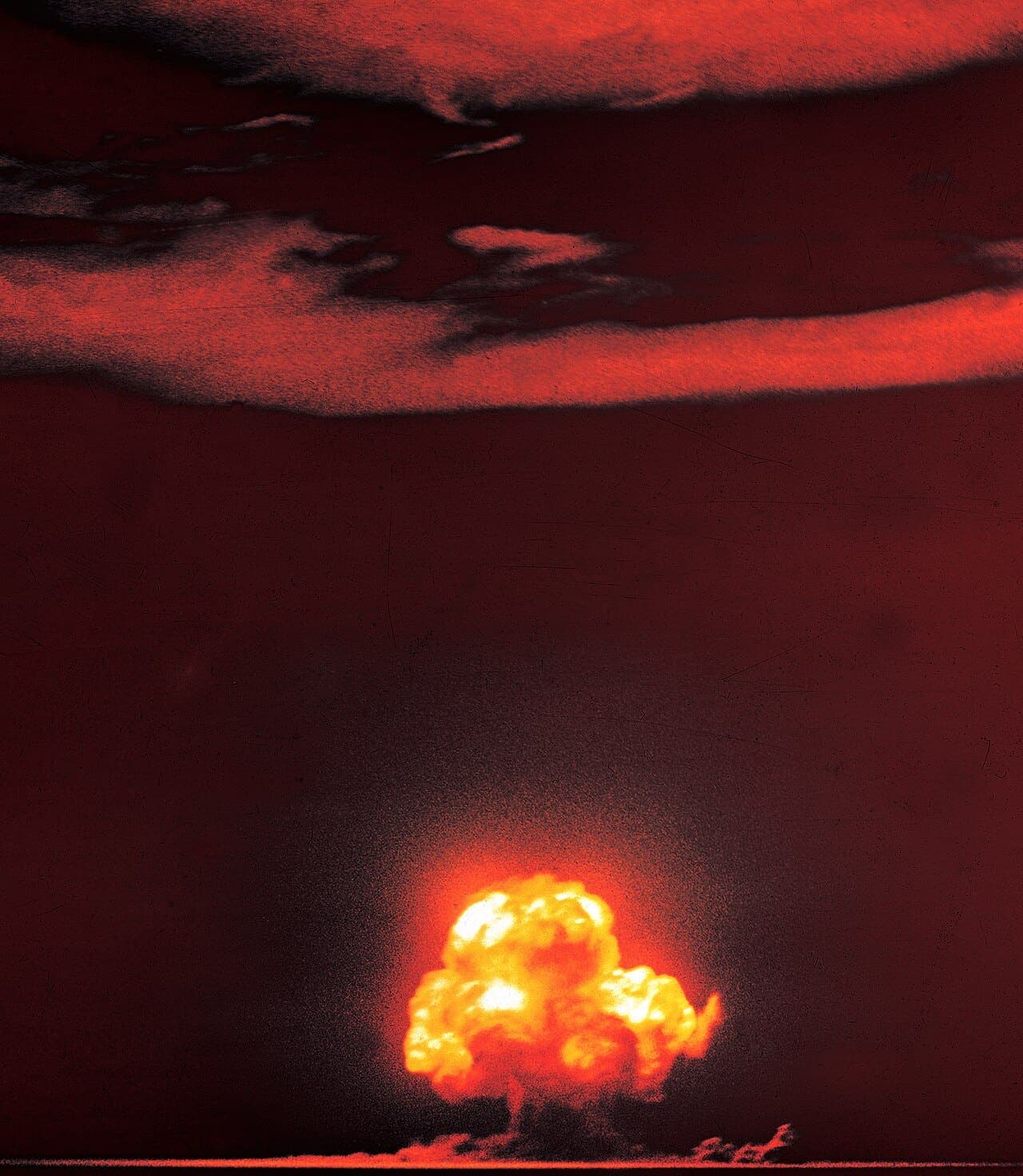
July 16, 1945: Trinity
By late spring 1945, Los Alamos had accumulated enough material for three devices: one gun-type uranium bomb (untested, saved for use), and two plutonium implosion bombs — one for testing, one for use.
The test site — code named Trinity, the name chosen by Oppenheimer after a John Donne sonnet — was a remote section of the Alamogordo Bombing Range in southern New Mexico. The device, called "the Gadget," was raised 100 feet up a steel tower.
At 5:29:45 AM on July 16, 1945, after a brief delay for thunderstorms, it detonated.
The yield was approximately 21 kilotons — roughly equivalent to what would fall on Nagasaki three weeks later.
The fireball rose 40,000 feet. The blast was heard 160 miles away. Windows shattered in houses 120 miles distant. A desert-floor material called trinitite — glass fused from silica sand by the heat — was scattered across a half-mile radius around ground zero.
Oppenheimer, watching from a bunker 10,000 yards away, later recalled that a line from the Bhagavad Gita came to mind: "Now I am become Death, the destroyer of worlds."
Fermi, characteristically, was tearing paper into strips to estimate the blast yield from how far they scattered in the shock wave. His estimate: 10 kilotons. Close enough.
The Decision to Use the Bombs
Germany had surrendered on May 8, 1945 — before either bomb was ready. Japan was the remaining target.
The decision to use the bomb was not a single moment but a series of assumptions and planning decisions made over years. No formal debate over alternatives appears in the historical record at the level of President Truman. The bombs were available, Japan had not surrendered after the Potsdam ultimatum, and using them was the plan.
On August 6, Little Boy fell on Hiroshima. On August 9, Fat Man fell on Nagasaki. Japan surrendered on August 15.
Between 129,000 and 226,000 people died, the vast majority civilians.
The Aftermath: The Soviet Bomb and the Cold War
The Manhattan Project succeeded — but it did not preserve American nuclear monopoly for long.
On August 29, 1949, the Soviet Union detonated "Joe-1" at the Semipalatinsk Test Site in Kazakhstan, four years after Hiroshima. American analysts, expecting a Soviet bomb no sooner than the mid-1950s, were stunned.
The speed was not accidental. Klaus Fuchs — the British theoretical physicist who had worked at Los Alamos on the implosion design — had been a Soviet agent throughout. He passed detailed technical information on the Fat Man implosion design to Soviet handlers, including dimensions, materials, and test results. When the British arrested Fuchs in January 1950, he confessed immediately.
The Rosenbergs — Julius and Ethel — were executed in 1953 for their role in the same intelligence network.
The Soviet bomb triggered a decision that defined the Cold War: whether the United States should develop the hydrogen bomb, a weapon that used nuclear fission as a trigger to detonate a far more powerful fusion reaction. Oppenheimer, serving as chairman of the General Advisory Committee to the Atomic Energy Commission, recommended against it on moral grounds.
Edward Teller and Stanisław Ulam developed it anyway. The first US hydrogen bomb, Ivy Mike, was tested on November 1, 1952. Its yield: 10.4 megatons — 500 times the Hiroshima bomb.
The Destruction of Oppenheimer
J. Robert Oppenheimer's postwar fate is inseparable from the story of the weapon he built.
His opposition to the hydrogen bomb, his pre-war associations with Communist Party members (including his brother and former fiancée), and his political influence over nuclear policy made him a target during the McCarthy era's anti-Communist purges.
In December 1953, President Eisenhower ordered a "blank wall" erected between Oppenheimer and classified information while a security hearing was conducted. The hearing, which ran from April to May 1954, produced a verdict that reads as a verdict on character rather than loyalty: Oppenheimer was found to be a person whose "character and associations reflect a serious disregard for the requirements of the security system" — but not a spy, not a traitor.
His security clearance was revoked. He was effectively removed from government service. The man who had built the bomb that ended the Second World War was deemed too dangerous to know its secrets.
In 2022, the US government formally vacated the 1954 security hearing, acknowledging it had been "fundamentally unfair." The decision came three days before the release of Christopher Nolan's film Oppenheimer, which introduced the Manhattan Project to a new generation.
The physicists have known sin; and this is a knowledge which they cannot lose.
— J. Robert Oppenheimer, lecturing at MIT, November 1947
What the Manhattan Project Changed
The Manhattan Project did not simply produce a weapon. It produced a model — of how governments, scientists, and industry could be mobilized together toward a technological objective at industrial scale — that shaped science policy, weapons development, and the relationship between states and knowledge for the rest of the century.
It also produced the architecture of the nuclear age:
Deterrence doctrine: The existence of nuclear weapons changed the logic of great-power conflict. Two nuclear-armed states could no longer fight each other without risking mutual annihilation — which created both a kind of stability and a kind of permanent danger.
The arms race: The Soviet bomb in 1949, combined with the American hydrogen bomb program, created the arms race dynamic that drove both superpowers to accumulate tens of thousands of warheads over the following decades.
Non-proliferation: Every subsequent effort to prevent nuclear weapons from spreading — the NPT of 1968, the IAEA inspection regime, the negotiations with Iran and North Korea — is an attempt to prevent the Manhattan Project from being replicated. None has fully succeeded.
The project that Oppenheimer directed in the mountains of New Mexico, that 130,000 workers built in secret factories they didn't understand, that cost as much as the entire US automobile industry — its consequences are still unfolding.