How Nuclear Bombs Work: Fission, Fusion, and Weapon Physics
Nuclear weapons release energy through fission or fusion. Learn gun-type and implosion designs, hydrogen bombs, yield, and the Teller-Ulam model.
Staff Reporting and Analysis. Produces source-backed reporting, explainers, and reference pages on nuclear risk, proliferation, and escalation dynamics.
Key Sources
Start with the strongest supporting documents and reporting behind this page.
Primary Documents
Start with the strongest official or documentary records behind this explainer.
Where This Matters Now
Recent articles where this concept is actively shaping the current crisis.
In Current Coverage
Hiroshima and Nagasaki: What Happened When the Bombs Fell
On August 6 and 9, 1945, U.S. atomic bombs devastated Hiroshima and Nagasaki. Here is what happened, who died, and what radiation did after.
2026-03-03
In Current Coverage
What Would Happen If Nuclear War Started? A Step-by-Step Guide
What happens if nuclear war starts? From first launch to nuclear winter: blast zones, fallout, infrastructure collapse, and long-term survival risks.
2026-03-03
In Current Coverage
Tsar Bomba: The Biggest Nuclear Weapon Ever Tested
Tsar Bomba, tested by the Soviet Union on October 30, 1961, yielded about 57 megatons, becoming the most powerful man-made explosion ever recorded.
2026-03-03
Related Concepts
Companion explainers that deepen the strategic logic around this topic.
Concept
Dirty Bomb vs Nuclear Bomb: Key Differences
Dirty bomb vs nuclear bomb explained: hazard size, radiation risk, survival steps, and when to shelter or evacuate based on official guidance.
2026-03-11
Concept
Nuclear Winter Effects: Climate and Food
Nuclear winter effects explained: how soot cools climate, cuts harvests, and creates famine risk after nuclear war.
2026-05-26
Concept
What Is Launch-on-Warning?
Launch-on-warning is a posture that allows missiles to launch before incoming warheads land. This explainer covers incentives, risks, and safeguards.
2026-03-04
Nuclear weapons release more energy in a fraction of a second than a city's entire electrical grid produces in years. That energy comes not from chemistry — not from burning or oxidizing — but from changes in the nuclei of atoms themselves. Understanding how this works explains why nuclear weapons are categorically different from any other weapon ever built.
Why Nuclear Energy Is Different
Every chemical explosion — dynamite, TNT, a car bomb — releases energy by rearranging chemical bonds between atoms. The atoms themselves are unchanged; only their connections are reorganized.
Nuclear weapons are different in kind, not just degree. They release energy from changes within atomic nuclei — the dense core of protons and neutrons that contains nearly all of an atom's mass.
The energy involved is described by Einstein's famous equation: E = mc². Even a tiny mass (m), when converted to energy, produces an enormous result because c — the speed of light — is approximately 300 million meters per second, and the equation uses c². This is why a kilogram of fissioned uranium-235 releases energy equivalent to roughly 17,000 tons of TNT, while burning that same kilogram of coal produces energy equivalent to only a few tons.
Two physical processes can unlock this energy:
- Fission — splitting a heavy nucleus into lighter fragments, releasing energy
- Fusion — combining two light nuclei into a heavier one, also releasing energy
Both processes release energy because the resulting products have slightly less mass than the original nuclei — the "missing" mass is converted to energy via E = mc².
Fission: Splitting the Atom
What makes a nucleus fissile
Not every atom can sustain a nuclear chain reaction. The key property is that the nucleus must be capable of being split by a slow (thermal) neutron and, when split, must release more neutrons than it absorbed.
Two isotopes meet this requirement at the scale needed for weapons:
- Uranium-235 (U-235): Naturally occurring, comprising 0.7% of natural uranium. Must be enriched to weapons-grade (>90% purity) through isotope separation.
- Plutonium-239 (Pu-239): Does not exist in nature. Produced in nuclear reactors when uranium-238 absorbs a neutron.
When a U-235 or Pu-239 nucleus absorbs a neutron, it splits into two lighter nuclei (fission products) and releases 2–3 additional neutrons plus approximately 200 million electron volts of energy. Those neutrons can trigger further fissions — a chain reaction.
Critical mass: the threshold for explosion
A self-sustaining chain reaction requires a critical mass — enough fissile material assembled in the right geometry that more neutrons are produced than escape the surface. Below critical mass, too many neutrons escape before causing further fissions; the reaction dies.
For a bare sphere of weapons-grade U-235, the critical mass is approximately 52 kg (115 lbs). For Pu-239, it is approximately 10 kg (22 lbs).
These numbers can be dramatically reduced by:
- Surrounding the fissile material with a neutron reflector (such as beryllium or natural uranium), which bounces escaping neutrons back into the core
- Compressing the fissile material to higher density, reducing the mean free path of neutrons
Modern implosion weapons achieve super-criticality primarily through compression: the plutonium core is initially assembled in a sub-critical geometry, then compressed by surrounding conventional explosives to many times its normal density, producing criticality that would not exist at normal density.
Why plutonium can't use a gun-type design
Gun-type fission weapons (like the Hiroshima bomb) work by firing one sub-critical mass down a barrel into another. This works for uranium but fails for reactor-grade plutonium: the Pu-240 contaminant produced in reactors undergoes spontaneous fission at a rate high enough to pre-initiate the reaction — starting the chain reaction while the two masses are still approaching each other, producing a low-yield "fizzle." Plutonium weapons must use implosion, which achieves assembly fast enough to outrun pre-initiation.
The Two Fission Weapon Designs
Design 1: Gun-Type
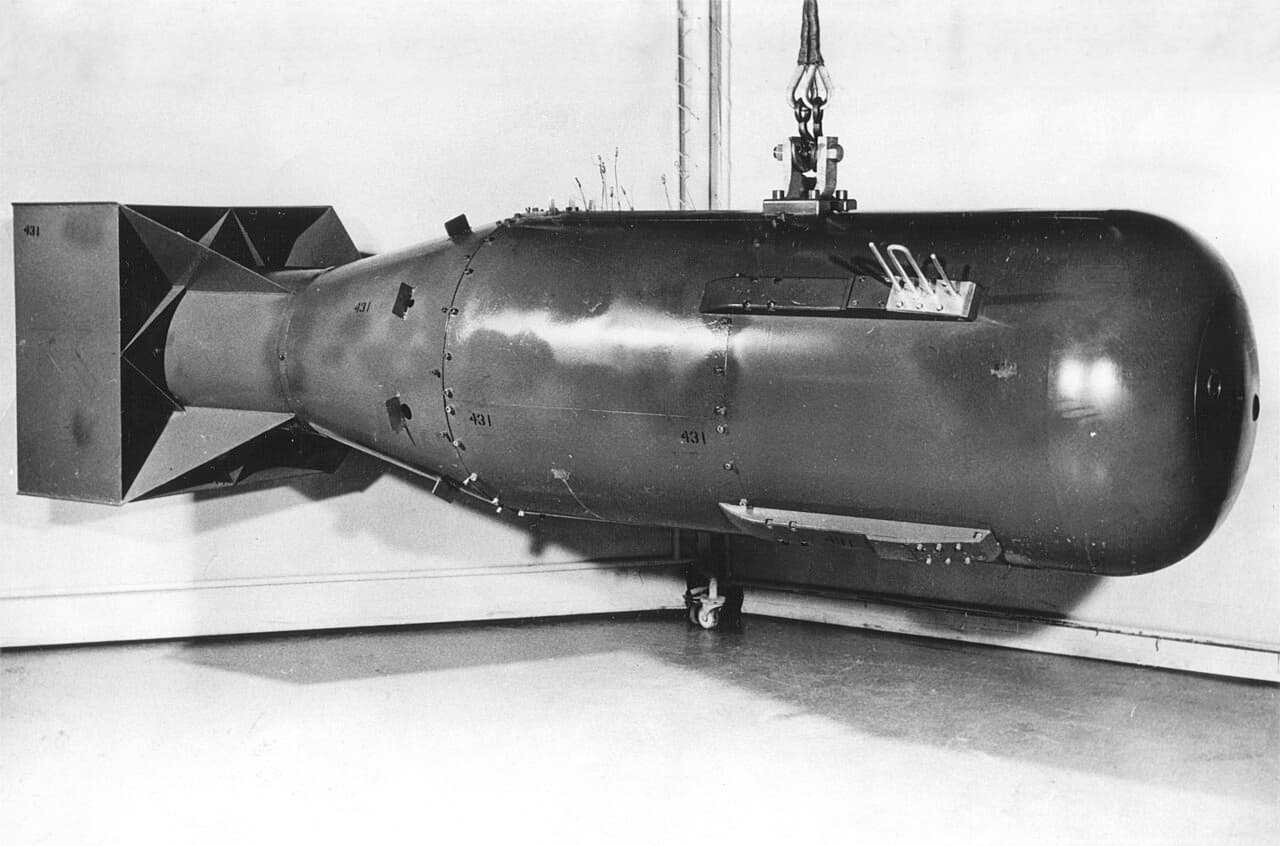
The gun-type weapon is the simplest nuclear weapon concept. A conventional explosive fires a sub-critical mass of U-235 ("the bullet") down a gun barrel into a second sub-critical mass ("the target"). The combined mass exceeds critical mass; a supercritical chain reaction begins.
Little Boy, the Hiroshima bomb, used this design:
- Weapon length: 10 feet (3 meters)
- Weight: 9,700 lbs (4,400 kg)
- Fissile core: approximately 64 kg of 80%-enriched uranium-235
- Yield: approximately 15 kilotons
- Efficiency: less than 2% — only about 1 kg of the uranium actually fissioned
The gun-type design is simple and reliable but wasteful: it requires large quantities of enriched uranium and its efficiency is inherently low because the early part of the chain reaction blows the core apart before it can fully react. Modern arsenals do not use gun-type weapons.
Design 2: Implosion
The implosion design uses precisely shaped conventional explosive "lenses" arranged around a sub-critical sphere of plutonium (or uranium). When the lenses detonate simultaneously, they generate a perfectly spherical inward-directed shock wave that compresses the fissile core to several times its normal density.
This compression drives the core into a highly supercritical state. A neutron initiator at the center — triggered at the moment of maximum compression — starts the chain reaction.
Fat Man, the Nagasaki bomb, used this design:
- Weapon diameter: 5 feet (1.5 meters), spherical
- Weight: 10,300 lbs (4,670 kg)
- Fissile core: approximately 6.4 kg of plutonium-239
- Yield: approximately 21 kilotons
- Efficiency: roughly 20% — far higher than gun-type
Every nuclear weapon in every modern arsenal uses an implosion design or a design derived from it. The geometry is more complex to manufacture but allows smaller cores, higher efficiency, and makes plutonium weapons possible.
Boosted Fission Weapons
A "boosted" fission weapon introduces a small quantity of fusion fuel — typically a mixture of deuterium and tritium (hydrogen isotopes) — into the core. When the fission chain reaction begins, the extreme heat and pressure trigger a small fusion reaction in the deuterium-tritium gas. This fusion reaction releases additional neutrons, dramatically accelerating and completing the fission chain reaction.
Boosting does not primarily add fusion yield — the fusion contribution to total yield is small. Rather, it dramatically increases the efficiency of the fission reaction, allowing smaller amounts of fissile material to achieve higher yields. Most modern tactical and strategic warheads use some form of boosting.
Thermonuclear (Hydrogen) Bombs
Pure fission weapons face a physical ceiling: as the chain reaction proceeds and the core heats up, the core blows itself apart before all the fissile material can react. Increasing the amount of fissile material doesn't proportionally increase the yield because the assembly becomes inefficient above a certain size.
The hydrogen bomb, or thermonuclear weapon, breaks through this ceiling.
Fusion physics
Fusion releases energy when two light nuclei combine. The most energetic accessible fusion reaction is deuterium-tritium (D-T) fusion, which produces a helium nucleus and a high-energy neutron, releasing about 17.6 million electron volts — comparable per event to fission.
But fusion requires extreme temperature and pressure to initiate: approximately 100 million degrees Celsius, far hotter than the surface of the sun. The only feasible way to achieve this in a weapon is to use a fission bomb as a trigger.
The Teller-Ulam design
In 1951, Edward Teller and Stanisław Ulam discovered the key insight that makes thermonuclear weapons work: radiation implosion.
The Teller-Ulam design (still classified in its details, but publicly described in general terms) uses two stages inside a radiation case:
- The primary — a boosted fission bomb that explodes first
- The secondary — a compressed cylinder of fusion fuel (lithium-6 deuteride) and a fissile "spark plug"
When the primary detonates, its X-ray radiation — traveling faster than the mechanical shock wave — reaches and ablates (vaporizes) the outer surface of the secondary's radiation case. The ablation generates an inward pressure that compresses the secondary's fusion fuel far more rapidly and uniformly than any mechanical means could. The central fissile spark plug fissions first, heating the compressed fusion fuel to ignition temperatures, triggering a large-scale fusion reaction.
The result: the fusion reaction can be scaled almost without limit by increasing the amount of fusion fuel. This is why hydrogen bombs are measured in megatons (millions of tons of TNT) rather than kilotons.
| Weapon type | Mechanism | Practical yield range |
|---|---|---|
| Gun-type fission | Sub-critical masses driven together | 10–25 kt |
| Implosion fission | Explosive compression of fissile core | 1–500 kt |
| Boosted fission | Fission + D-T fusion enhancement | 5 kt – 1 Mt |
| Thermonuclear (staged) | Fission primary + radiation-imploded fusion secondary | 50 kt – 50+ Mt |
Why fusion fuel is safer to store
An additional practical advantage of thermonuclear weapons: the fusion fuel (lithium-6 deuteride) is a solid compound that is stable and non-fissile. The weapon is not critical unless the fission primary detonates; an accident with the conventional explosives cannot produce a nuclear yield. This safety advantage has made thermonuclear designs dominant in modern arsenals, even for relatively low-yield warheads.
How Yield Is Measured and What It Means
Nuclear weapon yield is measured in kilotons (kt) or megatons (Mt) of TNT equivalent — the quantity of TNT that would release the same energy.
- 1 kiloton = 1,000 tons of TNT = about 4.18 × 10¹² joules
- 1 megaton = 1,000,000 tons of TNT = 4.18 × 10¹ⵠjoules
Yield comparison:
| Device | Type | Yield | Equivalent |
|---|---|---|---|
| Little Boy (Hiroshima) | Gun-type fission | 15 kt | 15,000 tons TNT |
| Fat Man (Nagasaki) | Implosion fission | 21 kt | 21,000 tons TNT |
| W88 (US Trident SLBM) | Thermonuclear | 475 kt | 475,000 tons TNT |
| Tsar Bomba (Soviet test) | Thermonuclear | ~57 Mt | 57,000,000 tons TNT |
Yield does not scale linearly with destructive area. Because blast pressure dissipates as the cube of distance, doubling the yield increases the blast radius by only about 26% (the cube root of 2). A 1-megaton bomb does not destroy ten times the area of a 100-kiloton bomb; it destroys approximately 2–3 times the area.
This is one reason why arms race logic eventually favored large numbers of moderate-yield weapons over a few massive ones: more warheads covering more targets more efficiently than a single enormous bomb.
Tactical vs. strategic nuclear weapons
Nuclear weapons are often classified as "tactical" (designed for battlefield use, typically under 50 kt) or "strategic" (designed to destroy cities and military-industrial infrastructure, typically 100 kt and above). Russia currently possesses an estimated 1,900 tactical nuclear warheads; the United States approximately 200. The distinction matters because tactical weapons have lower launch authorization thresholds and are more likely to be used early in a conflict — making them the most dangerous weapons in current arsenals from the perspective of nuclear escalation.
What a Nuclear Explosion Actually Produces
When a nuclear weapon detonates, the energy releases in several distinct forms:
- Blast (50%): The shock wave of compressed air. Responsible for most structural destruction and most deaths in cities.
- Thermal radiation (35%): Intense visible and infrared light that ignites fires and causes severe burns at ranges well beyond the blast zone.
- Prompt radiation (5%): Gamma rays and neutrons emitted in the first minute. Lethal within a relatively small radius (smaller than the blast zone for large weapons).
- Residual radiation / fallout (10%): Radioactive particles produced by the nuclear reaction, carried downwind. Lethal over a much larger area but decays over days to weeks.
For weapons above approximately 100 kilotons, thermal effects and the potential for firestorms typically cause more casualties than the initial blast — and the area affected by firestorm, which the bomb itself can ignite but cannot control, extends far beyond the calculable blast radius.
The Current Nuclear Landscape
Every nuclear weapon in every major arsenal — Russian, American, British, French, and Chinese — is a thermonuclear weapon based on the Teller-Ulam two-stage design. The variations are in yield optimization, safety systems, delivery methods, and size (modern warheads are far smaller than the first-generation designs), but the underlying physics is the same.
Indian, Pakistani, and North Korean weapons are believed to be fission or boosted-fission designs; whether North Korea has demonstrated a true thermonuclear capability is debated.
The fact that thermonuclear weapons now represent the overwhelming majority of global nuclear yield means that the destructive potential of even a "limited" nuclear exchange is difficult to overstate. A single Ohio-class submarine carries 24 Trident II missiles, each carrying up to 8 W88 warheads of 475 kilotons each. That single submarine can deliver 24 times the destructive energy of all the weapons used in World War II combined.