NATO Nuclear Sharing Explained: Weapons, Bases, and Limits
NATO nuclear sharing explained: how U.S. B61 bombs, dual-capable aircraft, custody, and NPT limits work in Europe.
Staff Reporting and Analysis. Produces source-backed reporting, explainers, and reference pages on nuclear risk, proliferation, and escalation dynamics.
Key Sources
Start with the strongest supporting documents and reporting behind this page.
Primary Documents
Start with the strongest official or documentary records behind this explainer.
Where This Matters Now
Recent articles where this concept is actively shaping the current crisis.
In Current Coverage
New START Treaty Expiration 2026: What Changes Now
New START treaty expiration 2026 ended verified U.S.-Russia limits. See what changes for warheads, inspections, and escalation risk now.
2026-03-18
In Current Coverage
Able Archer 83: The 1983 Nuclear War Scare Explained
Able Archer 83 was a NATO drill in November 1983 that Moscow misread as a first strike, pushing Cold War tensions to their most dangerous point.
2026-03-03
In Current Coverage
Hiroshima and Nagasaki: What Happened When the Bombs Fell
On August 6 and 9, 1945, U.S. atomic bombs devastated Hiroshima and Nagasaki. Here is what happened, who died, and what radiation did after.
2026-03-03
Related Comparisons
Comparison pages that show how this concept plays out across rivalries, arsenals, and crisis analogies.
Related Concepts
Companion explainers that deepen the strategic logic around this topic.
Concept
Tactical vs Strategic Nuclear Weapons: Key Differences
Tactical vs strategic nuclear weapons explained with doctrine, ranges, yields, targets, and escalation risk so you can read nuclear headlines without confusion.
2026-04-27
Concept
What Is Mutually Assured Destruction (MAD)?
What is mutually assured destruction (MAD)? We explain the doctrine, Cold War logic, modern criticisms, and why MAD still shapes nuclear strategy.
2026-03-03
Concept
Nuclear Triad Explained: Structure, Purpose, and Tradeoffs
Nuclear triad explained: how land, sea, and air nuclear forces work, why states keep all three legs, and what this means for deterrence risk in 2026.
2026-04-01
NATO nuclear sharing is not a transfer of nuclear weapons to allied ownership; it is a deterrence arrangement in which the United States keeps custody and control of forward-deployed weapons while selected allies provide dual-capable aircraft, trained crews, basing support, and political consultation. The topic matters in 2026 because European assurance debates, B61-12 modernization, and NATO's nuclear deterrence policy all affect how readers should interpret nuclear-risk headlines.
What is NATO nuclear sharing?
NATO nuclear sharing is a burden-sharing model inside the alliance's broader nuclear deterrence posture. In peacetime, U.S. nuclear weapons assigned to the mission remain under U.S. custody. Participating allies train, maintain certified aircraft, support basing infrastructure, and take part in nuclear consultations through NATO institutions.
The arrangement is easy to misread because the phrase "sharing" sounds like ownership transfer. In practical terms, it is closer to a controlled readiness and consultation system. The United States supplies the weapons and retains custody; allied governments supply parts of the delivery and political support architecture.
What the arrangement includes
| Element | What it means | Why it matters |
|---|---|---|
| U.S. custody | U.S. personnel retain control over U.S. nuclear weapons in peacetime | Prevents allied ownership or independent use |
| Dual-capable aircraft | Certain allied aircraft train for conventional and nuclear delivery roles | Makes nuclear burden sharing visible and operational |
| Nuclear Planning Group | NATO forum for nuclear policy consultation | Gives non-nuclear allies a voice in deterrence policy |
| Basing support | Host infrastructure, security, storage systems, and exercises | Turns doctrine into deployable posture |
| Political assurance | Signal that U.S. extended deterrence is tied to European defense | Reduces allied pressure to build independent arsenals |
This makes NATO nuclear sharing part of the same conceptual family as extended deterrence, but it is more concrete than a promise alone. It includes aircraft, bases, training, command procedures, and alliance consultation.
How does NATO nuclear sharing work in practice?
The practical workflow has three layers: peacetime custody, crisis consultation, and wartime authorization. Public sources cannot describe every classified step, but enough is visible to understand the main guardrails.
Peacetime custody and readiness
In peacetime, U.S. weapons are not handed over to host countries. NATO says the United States maintains custody and control of its forward-deployed nuclear weapons. Allied participation centers on readiness: aircraft certification, aircrew training, exercises, infrastructure, and conventional support to nuclear operations.
That distinction is central. A host state can participate in the nuclear mission without possessing an independent nuclear stockpile. It can train aircraft and crews for a nuclear role without having unilateral authority to arm or employ U.S. weapons.
Crisis consultation and political control
If a crisis escalated toward possible nuclear use, political decisions would move through U.S. national authority and NATO consultation channels. Public descriptions usually emphasize two points: U.S. authorization remains necessary, and NATO nuclear policy is discussed through alliance bodies such as the Nuclear Planning Group.
The phrase "dual-key" appears often in public discussion, but it can oversimplify the process. The better description is layered authorization and cooperation: U.S. control over the weapon, host-nation control over aircraft and crews, and alliance-level consultation on policy.
Wartime release is the contested edge case
The most legally and politically contested moment is not normal peacetime storage. It is the hypothetical wartime point at which a U.S. weapon might be released for delivery by an allied aircraft. NATO argues the arrangement was built and understood before the Nuclear Non-Proliferation Treaty entered into force. Critics argue that training non-nuclear allies for nuclear delivery undermines the treaty's spirit even if peacetime custody remains U.S.
That dispute is why the page should be read with No First Use Nuclear Policy and Tactical vs Strategic Nuclear Weapons. Doctrine, custody, and escalation control intersect here.
Which weapons and aircraft are involved?
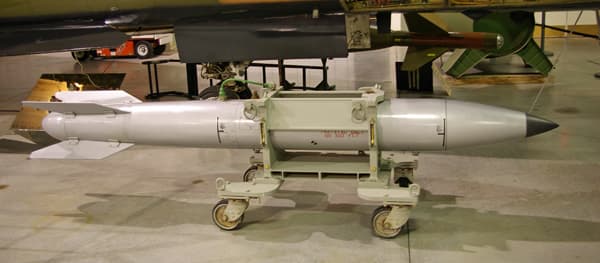
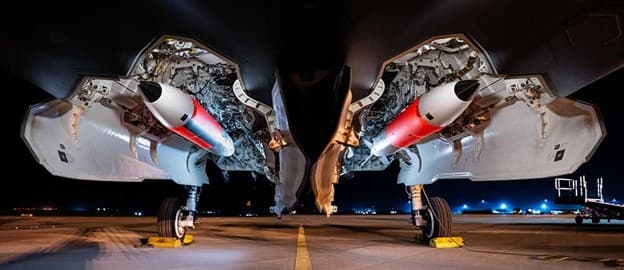
The weapons associated with NATO nuclear sharing are U.S. B61 gravity bombs, now centered on the B61-12 modernization program. The delivery side is built around dual-capable aircraft: aircraft able to perform conventional missions and certified nuclear missions.
B61 gravity bombs
The B61 is an air-delivered nuclear gravity bomb family. The National Nuclear Security Administration said the B61-12 Life Extension Program completed its last production unit in December 2024, with public release in January 2025. NNSA describes the B61-12 as a modernization that extends service life, consolidates older variants, and supports the U.S. air-delivered deterrent.
Dual-capable aircraft
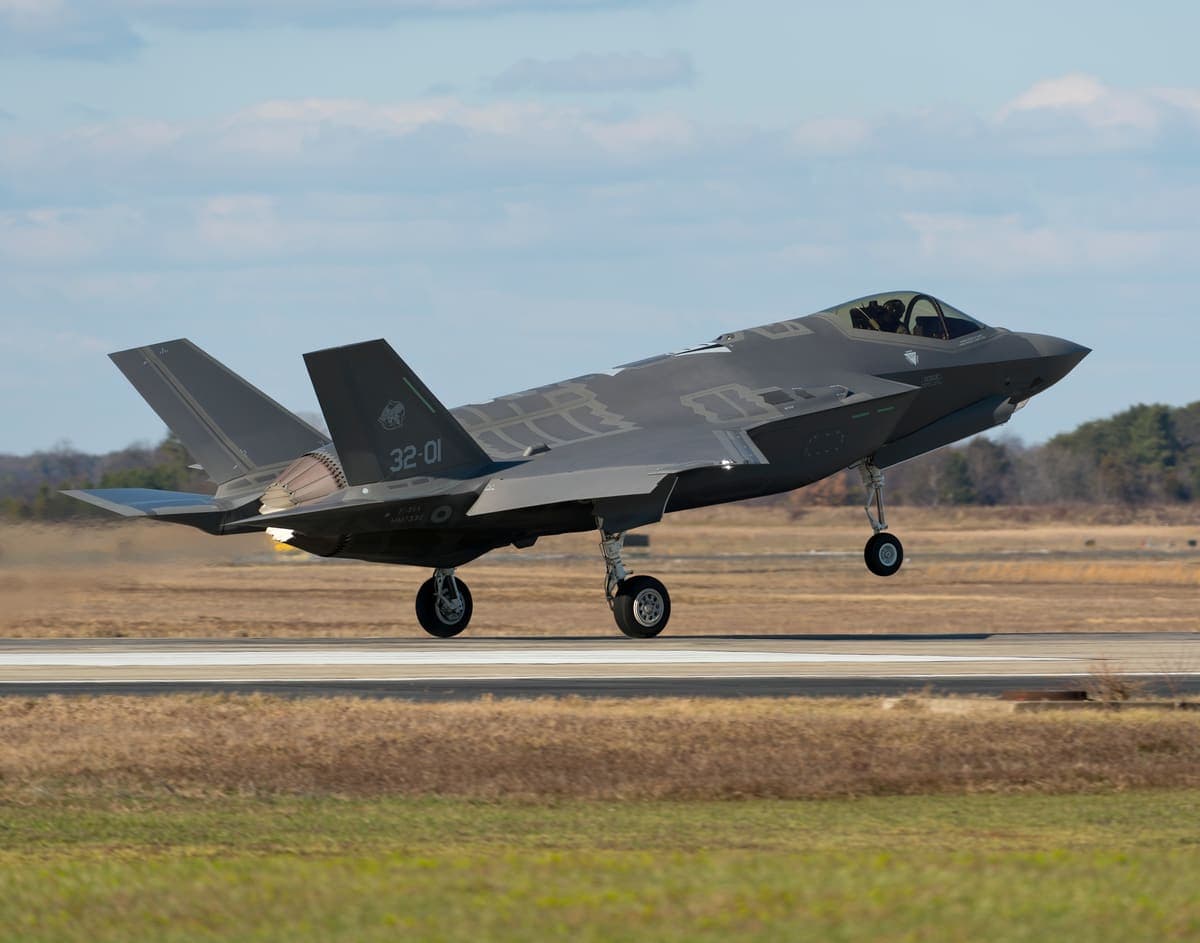
Dual-capable aircraft are the delivery platforms that make allied participation operational. Historically, several European allies used F-16 or Tornado aircraft in this role. The modernization path increasingly points to F-35A aircraft, which are being integrated into allied air forces and certified for nuclear mission requirements.
| Platform issue | Why it matters |
|---|---|
| Aircraft certification | A jet must be technically certified for the nuclear delivery role |
| Pilot training | Crews must maintain procedures without signaling imminent use |
| Base infrastructure | Storage, security, maintenance, and logistics must meet nuclear standards |
| Alliance interoperability | Nuclear missions must fit NATO command, air defense, and planning systems |
The aircraft question is not just hardware. It is about whether allies can keep a credible, safe, and politically accepted role in the mission as legacy fleets retire.
Why gravity bombs are different from missiles
Air-delivered gravity bombs are slower and more visible than ballistic missiles. That can be a disadvantage in a contested war, but it also creates a signaling function. Aircraft can be generated, dispersed, or recalled in ways missiles cannot. For NATO, that visibility is part of assurance: allies see that the United States remains physically tied to European defense.
This is why NATO nuclear sharing connects to Nuclear Triad Explained. It is not a triad leg by itself, but it uses the air-delivered part of the U.S. deterrent to reinforce allied defense commitments.
Which countries participate in NATO nuclear sharing?
NATO does not publish a live, site-by-site confirmation list for forward-deployed U.S. nuclear weapons. Open-source assessments generally identify Belgium, Germany, Italy, the Netherlands, and Turkey as long-standing host countries for U.S. B61 bombs, while 2026 reporting and Nuclear Notebook analysis have focused renewed attention on possible U.K. infrastructure at RAF Lakenheath.
Participation is broader than hosting bombs
Hosting weapons is only one form of participation. NATO says all allies in the Nuclear Planning Group participate in nuclear consultations, while some allies provide dual-capable aircraft, conventional support, exercises, or other planning contributions.
| Participation type | Example function | Strategic effect |
|---|---|---|
| Host-nation basing | Storage, security, and airbase infrastructure | Keeps U.S. weapons forward-deployed |
| DCA contribution | Aircraft and crews certified for nuclear roles | Shares operational burden |
| Conventional support | Escorts, refueling, air defense, logistics | Makes the mission executable |
| Political consultation | Nuclear Planning Group participation | Spreads policy ownership across the alliance |
This wider participation is why NATO describes the mission as alliance burden sharing rather than only a bilateral U.S.-host arrangement.
Why exact locations are treated cautiously
Exact locations matter for security and political reasons. Governments often neither confirm nor deny specific storage details. Open-source analysts use budget documents, aircraft certification, infrastructure changes, and historical records to estimate where weapons are stored, but readers should distinguish estimates from official confirmation.
For comparison, open-source nuclear-force estimates also support country profiles such as United States Nuclear Forces and Military Power Profile and broader force comparisons like Russia vs United States Nuclear Comparison. The same rule applies: use public estimates carefully, and avoid treating every site claim as official.
Is NATO nuclear sharing legal under the NPT?
This is the most persistent legal question. The Nuclear Non-Proliferation Treaty prohibits nuclear-weapon states from transferring nuclear weapons or control over them to non-nuclear-weapon states, and it prohibits non-nuclear-weapon states from receiving such weapons or control. The central dispute is how NATO nuclear sharing fits that rule set.
NATO's argument
NATO argues that the arrangement is consistent with the NPT because it predates the treaty, was known during negotiations, and keeps U.S. weapons under U.S. custody and control in peacetime. NATO also argues that the arrangements do not transfer nuclear weapons to non-nuclear allies during normal conditions.
Critics' argument
Critics argue that training non-nuclear allies to deliver nuclear weapons and maintaining infrastructure for that mission weakens the non-transfer norm. They often focus less on peacetime custody and more on the wartime release scenario, asking whether a conflict-time transfer would contradict the treaty's purpose.
Practical reading rule
Readers should separate three claims:
| Claim | Strongest way to evaluate it |
|---|---|
| "NATO says the system complies with the NPT" | True as a description of NATO's position |
| "No one disputes the arrangement" | False; critics and some states have long disputed it |
| "Allied countries own U.S. nuclear bombs" | False in peacetime; custody remains U.S. |
The most accurate summary is that NATO nuclear sharing is legally defended by NATO and politically contested by opponents. It is not a simple case of allied ownership.
Why is NATO nuclear sharing controversial in 2026?
The controversy has intensified because several pressures are converging at once: Russian nuclear signaling, the expiration of older arms-control guardrails, B61-12 modernization, F-35A transition, and European debate over U.S. reliability.
The assurance argument
Supporters argue that forward-deployed U.S. nuclear weapons reassure allies and reduce proliferation pressure. If European allies believe the U.S. nuclear umbrella is credible, they have less incentive to seek independent nuclear weapons or improvised alternatives. This is especially relevant when Russia is using nuclear rhetoric to coerce NATO and Ukraine policy.
The Congressional Research Service frames this as part of U.S. extended deterrence: regional nuclear capabilities can reassure allies, deter adversaries, and shape proliferation incentives.
The escalation argument
Critics argue that forward-deployed bombs create crisis targets, compress decision timelines, and increase the chance that conventional airbase activity is misread as nuclear preparation. In a fast crisis, aircraft movements, munitions handling, or exercise patterns can look more ominous than intended.
The hard tradeoff
NATO nuclear sharing can reduce proliferation risk by reassuring allies, but it can also increase escalation complexity by adding more bases, aircraft, and political actors to the nuclear signaling environment.
The arms-control argument
After New START treaty expiration in 2026, transparency and restraint debates are sharper. NATO nuclear sharing is not a strategic-warhead treaty issue in the same way New START was, but both topics affect the same risk environment: how much verified predictability exists around nuclear posture.
If the broader arms-control system weakens, every visible nuclear posture change carries more interpretive weight.
What would change if NATO nuclear sharing expands?
Expansion can mean several different things, and headlines often blur them. It could mean more weapons, more certified aircraft, new host countries, upgraded infrastructure, eastern-flank basing, or more frequent exercises. Each change has a different risk profile.
Expansion scenarios
| Scenario | What changes | Main risk question |
|---|---|---|
| More certified aircraft | More allied jets can perform the mission | Does readiness improve without raising false-alarm risk? |
| New host infrastructure | More bases can support the mission | Does geography reassure allies or provoke preemption fears? |
| More weapons in Europe | Actual deployed inventory rises | Does deterrence gain outweigh arms-race signaling? |
| More exercises | Crews train more visibly | Can NATO communicate intent clearly enough? |
| Eastern-flank posture | Nuclear role moves closer to Russia | Does assurance become escalation pressure? |
The most important question is not "Are there more nuclear weapons?" It is "Which part of the architecture changed?" A new aircraft certification is not the same as a new weapon deployment. A base-security upgrade is not the same as wartime release. Precision matters.
Geography changes the escalation math
Moving nuclear-support infrastructure east would change flight times, threat perceptions, and targeting assumptions. It could reassure exposed allies, especially those near Russia, but it could also raise the perceived value of early strikes against airbases in a crisis.
That is why serious analysis must include Nuclear Command and Control, not only arsenal size. Posture changes interact with warning systems, command authority, aircraft dispersal, and political consultation.
How should readers interpret NATO nuclear sharing headlines?
Use a structured checklist before treating a headline as escalation.
Five questions to ask first
- Is the report about weapons, aircraft, bases, exercises, or political consultation?
- Is it official NATO/U.S. policy, open-source analysis, or anonymous reporting?
- Does it involve actual warhead movement, or only aircraft certification and planning?
- Is the action reversible, such as an exercise, or durable, such as new storage infrastructure?
- Does the report distinguish allied participation from allied ownership?
What low-risk and high-risk signals look like
| Signal | Lower-risk interpretation | Higher-risk interpretation |
|---|---|---|
| F-35A certification | Modernizing an existing DCA mission | Adding more operational options under crisis pressure |
| Base upgrades | Safety and security modernization | Preparing new forward storage geography |
| NPG meetings | Routine policy consultation | Emergency coordination after escalation |
| Public deterrence statements | Assurance messaging | Coercive nuclear signaling if paired with force movement |
The point is not to dismiss concern. The point is to avoid treating every nuclear-sharing story as the same kind of event.
Common misconceptions about NATO nuclear sharing
Misconception 1: "Allies own U.S. nuclear weapons"
They do not own them in peacetime. The United States retains custody and control of U.S. nuclear weapons. Allied participation is operational and political, not independent ownership.
Misconception 2: "Nuclear sharing means instant nuclear use authority"
It does not. Nuclear use would require U.S. authorization, alliance consultation, host-state involvement, and operational execution steps. The process is not a unilateral allied launch option.
Misconception 3: "The only issue is bomb count"
Bomb count matters, but aircraft certification, storage infrastructure, geography, and political signaling can matter just as much. A posture change can be significant even if the estimated number of weapons stays flat.
Misconception 4: "The NPT debate is settled for everyone"
It is settled as NATO policy, but not as global political consensus. Some states and analysts continue to challenge the arrangement as contrary to the treaty's nonproliferation purpose.
FAQ: NATO nuclear sharing
Bottom line
The best way to understand NATO nuclear sharing is as an alliance assurance system with strict U.S. custody, allied operational participation, and continuing legal controversy. It is designed to deter coercion and reassure allies, but it also creates visible nuclear infrastructure that can be misread or targeted during crises.
For readers following nuclear-risk signals in 2026, the key is precision. Do not treat aircraft certification, base construction, weapon deployment, and emergency nuclear use as one category. Each has a different meaning for deterrence, arms control, and escalation risk.